Restaurant Marketing Workshop
How to keep your restaurant’s next viral hit from becoming a traffic jam
June 8, 2026 by Michael Beck — CEO, Inc Tank GTM
 ChatGPT
 Grok
Grok Perplexity
 Claude
A few days before the Restaurant Marketing Workshop, June 2-3 in Boston, my friend David "Rev" Ciancio and I made a series of decisions that, in hindsight, should probably have involved more adult supervision.
Over the course of 48 hours, we drove hundreds of miles, attended ten professional baseball games, set three world records for baseball attendance, squeezed in a 5K, slept selectively and somehow arrived at a restaurant marketing conference looking only moderately damaged.
By all conventional measures, we should have been exhausted.
Rev, however, decided this was the perfect time to deliver a keynote, which is fitting because conventional measures have never seemed particularly interesting to him.
If you've spent any time around Rev, you know he's usually the guy handing people the instruction manual. He's the marketing tactician; the person who can take a complicated problem and break it into a series of practical actions. That's why one of the first things he said surprised me. He opened by telling the audience that it felt strange to be talking about strategy because he's normally the tactics guy.
The funny thing is that by the end of the presentation, I realized he'd spent an hour teaching strategy while pretending to teach tactics.
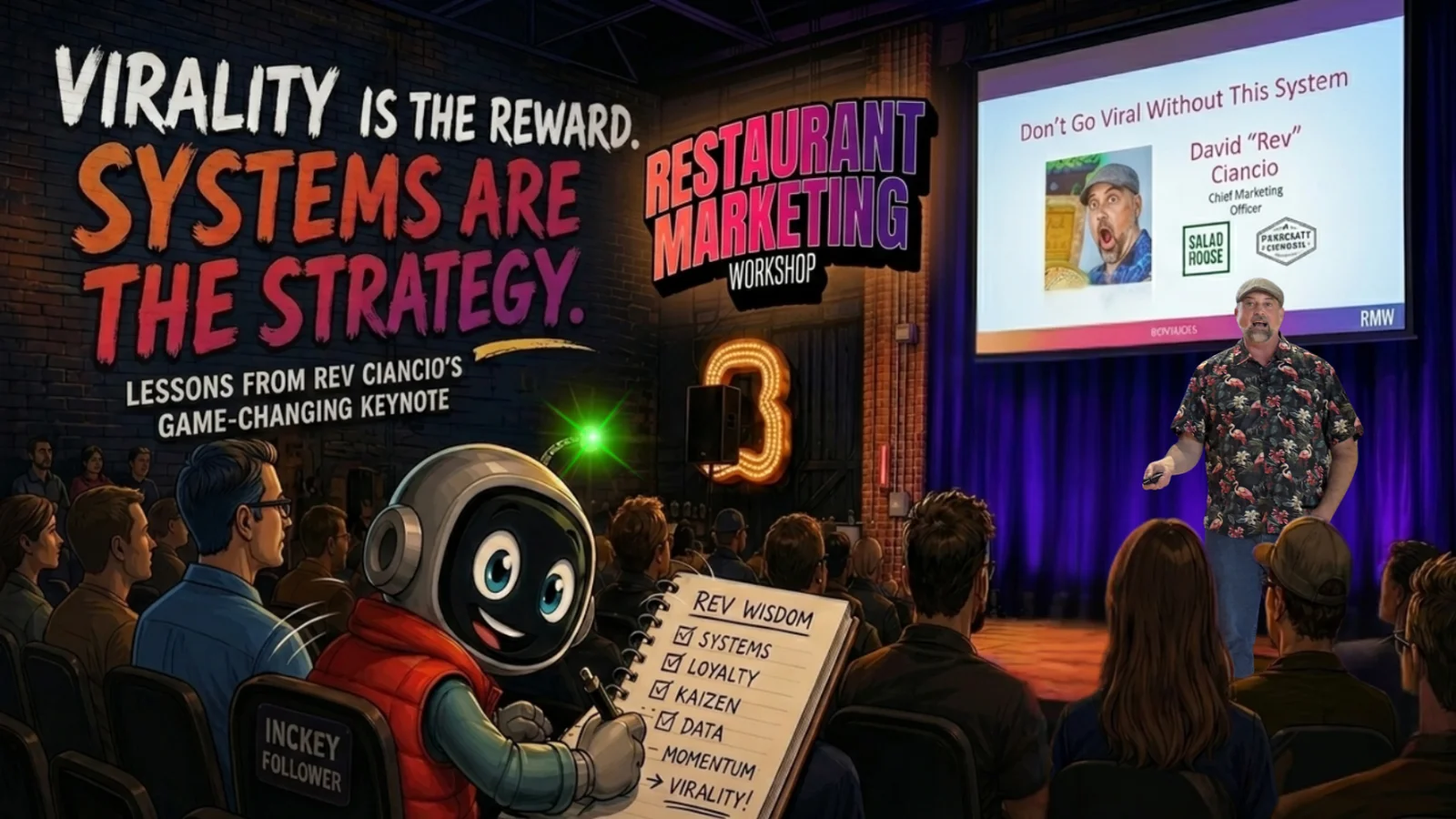
His presentation was called a framework for going viral.
It wasn't. At least not really.
Virality isn't the goal; it's the reward
It was a lesson on why most people misunderstand what makes virality valuable in the first place. The internet has convinced an entire generation of marketers that virality is the goal. Rev argued something subtly different. Virality is the reward. The goal is building a system strong enough to survive it.
Early in the presentation, he shared examples that most marketers would envy; restaurants that got visits from celebrity food personalities, brands that exploded because influencers showed up, and companies that suddenly found themselves at the center of a cultural moment.
The stories all sounded exciting until they didn't. In several cases, the attention faded. The crowds disappeared. The moment passed. The spike came and went.
That's when Rev landed on an idea that kept resurfacing throughout the keynote: a viral moment without a system behind it is just a temporary traffic jam. Lots of activity. Very little destination.
That observation stuck with me because it applies to far more than marketing.
Businesses love breakthrough moments. We celebrate product launches, media coverage, influencer campaigns, grand openings, and viral content because they feel like success. They create excitement. They generate stories. They give us something tangible to point at and say, "Look, it's working."
Attention and success are not the same
Attention is a visitor.
Success is what happens when you convince it to stay.
One of the subtle ideas running through Rev's keynote was that many brands accidentally confuse momentum with visibility. Visibility is easy to spot. You can see it in views, impressions, mentions, and traffic spikes. Momentum is harder to measure because it happens after the spotlight moves on. Momentum shows up when guests return. When loyalty grows. When word of mouth continues without being prompted. When a customer who discovered you through one campaign becomes part of the business for years.
The challenge is that attention feels like progress because it arrives all at once. Momentum feels slower because it is built gradually.
One gives you a headline. The other gives you a business.
It's about the systems
That's why Rev kept steering the conversation back toward systems. Systems are what transform moments into momentum. Without them, even great marketing can become little more than a temporary surge in activity. With them, a single successful campaign can continue creating value long after the internet has moved on to its next obsession.
What impressed me about Rev's presentation wasn't the tactics themselves. It was how relentlessly he kept returning to systems: guest feedback, customer data, loyalty programs, multi-channel communication, behavior analysis, measurement, and continuous improvement. None of those topics sound particularly sexy. Neither does brushing your teeth, yet ignoring either tends to create expensive consequences.
At one point Rev introduced the Japanese concept of Kaizen: continuous improvement through small, incremental changes. He explained that marketing isn't one brilliant campaign. It's a thousand small improvements compounded over time.
That's not how most people talk about marketing. Most people talk about marketing like it's fireworks. Rev talks about marketing like it's fitness. You don't become stronger because of one workout. You become stronger because you keep showing up.
Understanding human behavior
The deeper lesson wasn't about social media, either. It was about human behavior. One of the most interesting moments came when Rev challenged a statistic that sends many marketers into panic mode: roughly 70% of restaurant customers visit once and never return. Most marketers hear that and immediately ask, "How do we get those people back?" Rev's answer was surprisingly counterintuitive. Maybe that's the wrong question.
Instead of obsessing over people who barely know your brand, he suggested focusing on guests who already like you. Study the difference between customers who visit five times and customers who visit ten times. Understand the behaviors that move people deeper into loyalty rather than trying to reverse-engineer the habits of people who have already disappeared.
It's a simple shift, but it reveals something important.
Growth often comes from strengthening what already works rather than rescuing what doesn't. That's true in restaurants. It's true in business. It's true in life.
The best keynote speakers usually give audiences answers. Rev spent most of his keynote teaching people how to ask better questions.
- How do you know what your guests actually want?
- How do you know whether your marketing is working?
- How do you know which customers are becoming loyal?
- How do you know which efforts deserve more investment?
- How do you know what to improve next?
Those aren't tactical questions. They're strategic ones, which brings me back to the contradiction he opened with. Rev may call himself the tactics guy, but tactics are simply strategy wearing work boots. The best tactics don't exist independently. They serve a larger purpose.
Building businesses to benefit from virality
And the larger purpose of this keynote wasn't to teach people how to go viral. It was to teach them how to build businesses that can benefit from virality when it happens and continue growing when it doesn't.
That's a much harder lesson. It's also a much more valuable one because most businesses don't fail for lack of attention. They fail because they confuse attention with momentum. And that momentum comes from systems. Virality might get people through the door. What happens next determines whether they come back.
And that's where the real marketing begins.
Upcoming Events

Restaurant Marketing Workshop
June 2-3, 2026 | Boston
Restaurant Marketing Workshop will equip you with the latest strategies, tactics, and insights to drive brand awareness, customer engagement and revenue growth.
View AgendaRegister NowAbout Michael Beck
Michael Beck is the founder and CEO of Inc Tank GTM, a go-to-market and media consultancy helping technology companies accelerate growth through strategy, storytelling, and revenue execution. Over the past 14 years, he has helped generate more than $500 million in revenue for SaaS and hospitality technology companies. A Le Cordon Bleu-trained chef, Chat GTM Podcast host, and early technology adopter, Michael writes about restaurant innovation, AI, customer experience, and the people shaping the future of hospitality.
Related Media
Subscribe
Get the latest news and resources from Fast Casual.
Recent Posts

Recent Podcasts