Operations
Shawarma Press, Chicken Salad Chick, Firehouse Subs execs to talk operational complexities at Fast Casual Executive Summit
The upcoming "Complexity Killers" session at the Fast Casual Executive Summit will guide restaurant operators in auditing and streamlining their bloated tech stacks and operational procedures to eliminate margin-draining friction and protect profitability.
August 27, 2026 by Mandy Wolf Detwiler — Editor, Connect Media
 ChatGPT
 Grok
Grok Perplexity
 Claude
In the relentless drive to modernize, the fast casual industry fell into a dangerous trap: the belief that more is always better. Every new delivery tablet, labor-tracking software and 15-step closing checklist was implemented with the promise of efficiency, yet together, they have woven a web of daily operational friction.
The industry is at a tipping point where accumulated complexity isn't just overwhelming frontline staff — it is quietly bleeding unit-level margins. The most successful brands in 2026 aren't the ones adding to their tech stacks or operational manuals; they are the ones ruthlessly auditing operations to understand exactly which processes drive performance and which are simply dead weight.
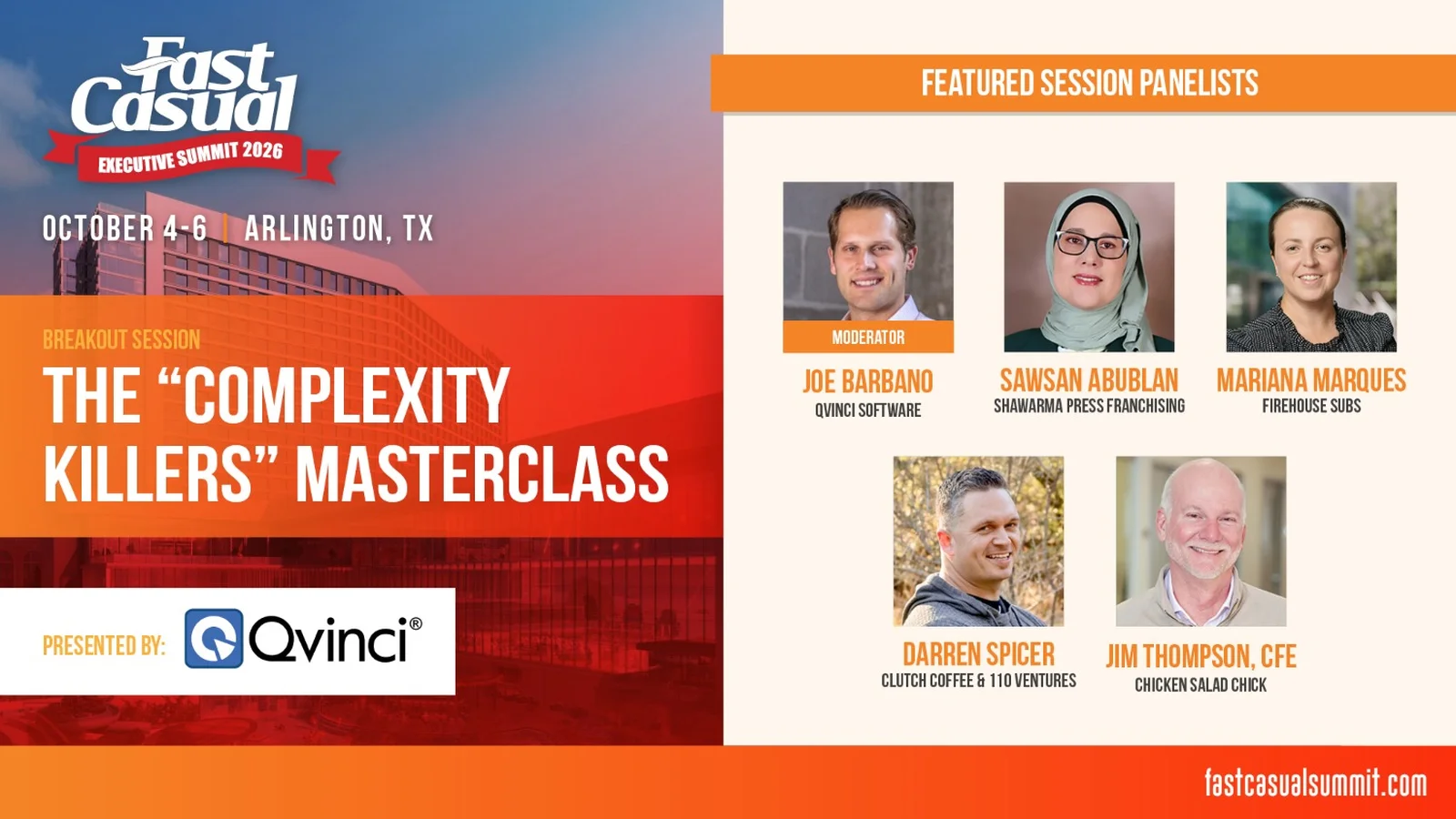
At the Fast Casual Executive Summit, talking place October 4-6, 2026, the session "The 'Complexity Killers' Masterclass" is designed to help restaurant brands view their entire operational ecosystem strictly through a profitability lens. Attendees will learn directly from industry-leading operators who have successfully detangled their SOPs, consolidated their tech stacks and streamlined menu execution by using comparative benchmarking and deep operational visibility.
The session, held Monday, Oct. 5 at 3:05 p.m., will uncover how to identify and eliminate the hidden tasks and fragmented tools that slow down your restaurants, allowing attendees to double down on the streamlined practices that actually protect and grow the bottom line.
Panelists include Sawsan Abublan, founder and CEO of Shawarma Press Franchising, Mariana Marques, senior director, operations excellence US&C of Firehouse Subs, Darren Spicer, CEO of 110 Ventures and Jim Thompson, COO of Chicken Salad Chick. Joe Barbano, chief revenue officer of session sponsor Qvinci Software, will moderate the panel.
Ahead of the event panelists shared insight on the panel topic via email interviews.
Q: Let's start with a reality check. What was the specific tool, tablet or 15-step process that finally made you step back and say, 'Okay, we have way too much going on'?
Marques: Honestly, there wasn't one tool or checklist that triggered it. Operations excellence sits at a unique intersection: supply chain, marketing, technology, digital, franchisee training. All of it eventually comes together in a single restaurant, in a single shift, through our team members. As the company grew and every team brought forward great ideas, the reality check was realizing someone needed to own translating all of that into something a restaurant could actually execute well, every day. That's the purpose operations excellence serves. We're not the department that says no. We're the department that makes sure yes works on the floor.
Q: Given Qvinci's deep expertise in multi-unit financial consolidation and comparative benchmarking, you have a unique vantage point on operational data across the industry. When fast casual operators finally get true, side-by-side visibility into their locations, what is the most common 'hidden complexity' — perhaps a specific tech tool, delivery channel or bloated labor SOP — that consistently shows up as a margin killer rather than a value driver?
Barbano: The most common margin killer is not one large expense. It is the cumulative cost of small exceptions repeated across every location.
What we most often uncover is not one dramatic expense or operational mistake. It is the cumulative cost of exceptions. For example, one location uses a non-standard vendor, another repeatedly pays for rush inventory deliveries, another adds an unnecessary labor step, and another makes small local spending decisions that appear immaterial in isolation. Across dozens, hundreds or thousands of locations, however, those exceptions create a significant and recurring drag on margin.
Side-by-side benchmarking makes that complexity visible. Operators can identify locations that consistently spend more on food, labor, delivery, technology, supplies, or other controllable expenses without generating better sales, service levels, or guest outcomes. The same can occur with delivery channels: incremental revenue may look attractive until commissions, discounts, packaging, additional labor, and other channel-specific costs are considered together.
The real value of comparative reporting is that it allows operators to distinguish legitimate local differences from avoidable operating inconsistencies. Once those patterns are visible, leadership can convert the practices of its highest-performing locations into repeatable system-wide standards.
Q: When looking through a 'profitability lens,' what is an operational hidden cost or time waster that most fast casual brands completely miss?
Abublan: Depending on the store design, employees may spend extra time replenishing packaging items like to-go containers, paper goods, and plastic bags when they are stored away from the service area. Even though this may look like "work" and gives the impression that employees are busy, but when you look at it closely it's a commonly missed operational cost.
Storing such items closer to the service area will reduce the time spent restocking and put this time back into actual productivity.
Q:Have you ever removed a menu item or an ingredient that actually sold well, simply because it was too complicated or labor-intensive for your kitchen to execute?
Marques: We're deliberately thorough before anything new goes into a restaurant. Every addition gets evaluated for what it costs the team, not just what it adds to the menu. Does it increase SKU count? Does it add prep steps or complexity during peak hours? Does it create inventory or waste risk? Can every location execute it consistently, not just our highest-performing ones? We'd rather say no to something with upside than say yes to something that only works in ideal conditions, because our team members are the ones who have to make it work every single day.
Q: When you compare your most profitable, high-performing locations to the rest of the pack, what operational habit or streamlined process usually sets the winners apart?
Abublan: If I can choose one thing that makes the highest performers shine is "consistency," they really and truly follow all policies and procedures "all the time". Other stores fall short on some procedures on some days and follow them on others, apply polices on certain occasions and turn the blind eye on others, but operational consistency is the key to success.
Q: We're discussing how every new tablet or tracker adds operational friction, yet new tech is constantly sold to operators as a silver bullet for efficiency. From your perspective, how should operators practically use their financial reporting to audit their own 'tech stack bloat,' so they can confidently decide which tools to cut and which ones actually drive revenue?
Barbano: Operators should be able to identify the measurable outcome each application is expected to produce — incremental revenue, lower labor hours, reduced food waste, faster throughput, improved retention, fewer errors or lower administrative costs.
The audit should begin by comparing the performance and trends of locations using the technology with similar locations that are not, as well as measuring results before and after implementation. Operators should also calculate the tool's full economic cost — not only the subscription fee, but also hardware, integrations, implementation, training, manager time, duplicate data entry and the operational friction created by adding another system.
That analysis depends on standardized, reliable financial data. When locations use inconsistent charts of accounts or record expenses differently, it becomes extremely difficult to determine whether a tool is improving profitability or simply adding another layer of complexity. Standardized reporting and location-level benchmarking allow operators to determine whether an application produces a repeatable improvement in contribution margin.
The objective should not be to eliminate technology indiscriminately. It should be to build a technology stack in which every tool earns its place through measurable improvements in unit-level economics. If a tool cannot demonstrate a defined financial or operational return — or substantially duplicates another system — it should be consolidated, renegotiated, or eliminated.
The takeaway
Ultimately, stripping away operational friction is about more than just reclaiming lost basis points; it is about fundamentally transforming the team member experience. When managers spend less time wrestling with redundant reporting tools and frontline staff aren't bogged down by convoluted, multi-step procedures, they can redirect their energy toward what actually matters: speed of service, food quality and guest satisfaction.
Fast Casual Executive Summit — Oct. 4-6, 2026 | Arlington, TX |
About Mandy Wolf Detwiler

Mandy Wolf Detwiler is the Pizzamarketplace.com and QSRweb.com editor for Connect Media. An award-winning journalist, Mandy brings more than 20 years’ experience covering food, people and places. Mandy has been featured on the Food Network and has won numerous awards for her coverage of the restaurant industry. She has an insatiable appetite for learning, and, yes, she can tell you where to find the best pizza slices in the country.
Featured Vendor

HungerRush brings every part of your restaurant together — orders, guests, data — in one platform built for fast casual and quick-serve multi-location brands ready to grow.
Subscribe
Get the latest news and resources from Fast Casual.
Recent Posts



Recent Podcasts