Technology
Beyond the algorithm: Don’t follow AI off a cliff
Artificial intelligence can analyze trends but cannot predict the future.
September 21, 2026 by Suzy Badaracco — President, Culinary Tides Inc
 ChatGPT
 Grok
Grok Perplexity
 Claude
Artificial intelligence can analyze enormous amounts of information, recognize established patterns, organize research and produce an answer before a human has finished pouring coffee.
There's just one problem when we ask it to predict future trends.
The future hasn't happened yet.
AI learns from what exists. Foresight lives partly in what doesn't— weak signals, changing emotional drivers, unexpected economic pressure, policy shifts, technological disruptions and seemingly unrelated events that collide and redirect human behavior.
Confuse the two, and AI can confidently lead your business somewhere you never intended to go.
Sometimes straight off a cliff as I explore in this movie script. It's also the topic of my presentation at theFast Casual Executive Summit, Oct. 4-6 in Arlington, Texas. Register here.
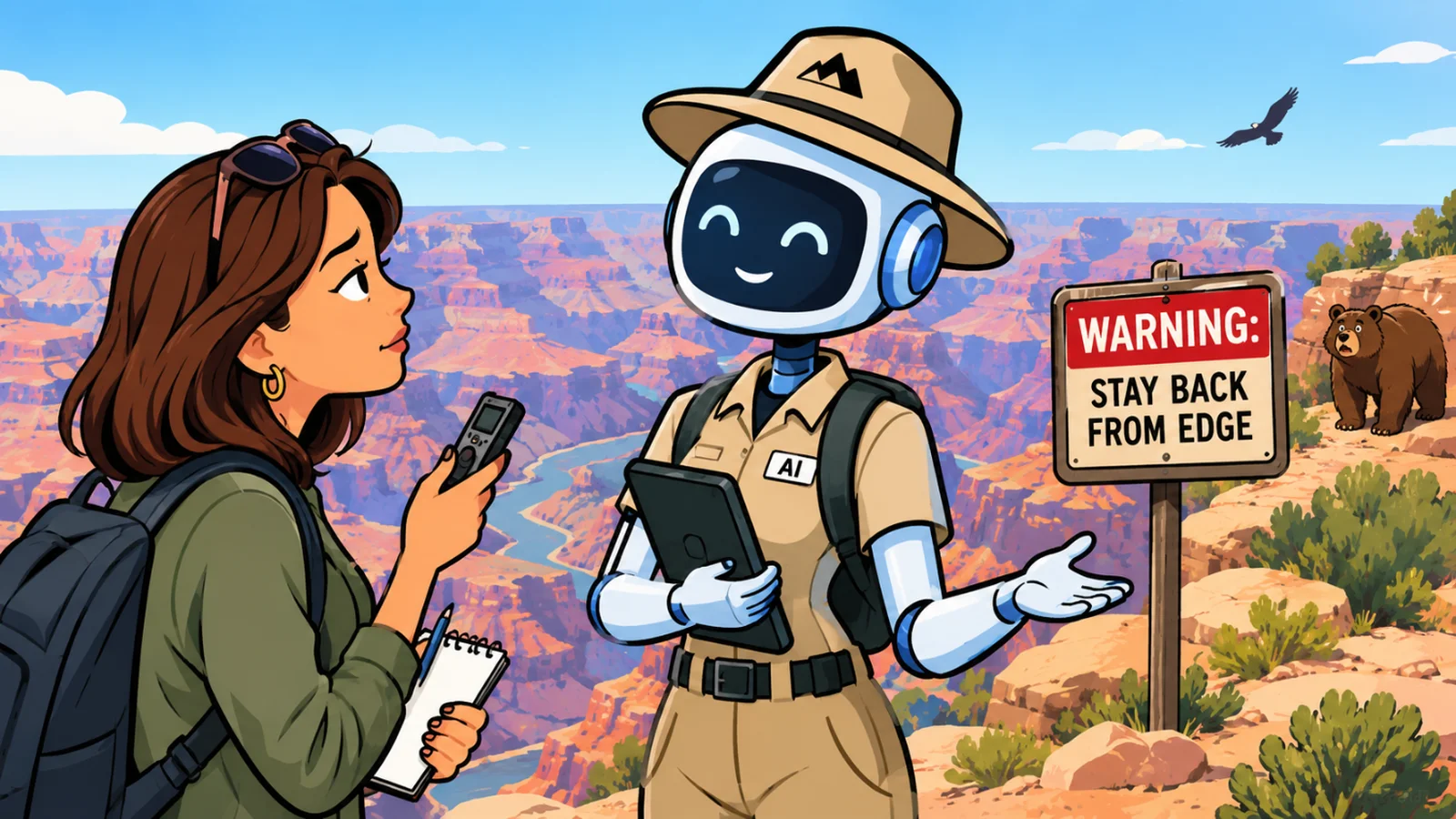
SETTING
GRAND CANYON — DAY
The view is spectacular.
Tourists photograph the canyon. Ravens circle overhead. A sign reads:
WARNING: STAY BACK FROM EDGE.
MAYA FACTCHECK: A seasoned food-industry reporter, switches on her recorder.
Maya has spent her career chasing facts, questioning executives, and separating meaningful change from corporate hype. She is curious, sharp, and accustomed to checking her sources—but even she has become impressed by AI. It can search, organize, analyze, and answer in seconds what once took hours.
Today, she has come to the Grand Canyon with what she assumes is a fairly straightforward question:
- If AI can analyze more information than any human possibly could, shouldn't it also be better at predicting what happens next?
She isn't here to challenge AI.
At least, not yet.
AI: An exceptionally pleasant Grand Canyon guide, stands beside her. Crisp uniform. Perfect posture. Tablet in hand. Helpful, charming, and reassuringly confident—the kind of guide you would follow without thinking twice.
Which, as Maya is about to discover, may be the problem.
SCENE 1: THE INTERVIEW
MAYA
You can analyze millions of data points in seconds. Why would anyone still need a human trend forecaster?
AI
Excellent question.
MAYA
Thank you.
AI
You're welcome.
MAYA
So?
AI
I can identify patterns across enormous quantities of existing information faster than any human.
MAYA
Exactly. So shouldn't you be better at predicting what happens next?
AI
That conclusion certainly sounds reasonable.
(A BUSINESS EXECUTIVE in hiking clothes approaches.)
EXECUTIVE
Sorry to interrupt. Fastest trail back to the lodge?
AI
Canyon Trail. Eight minutes shorter. Take the fork on your left.
(The executive disappears down the trail.)
EXECUTIVE (O.S.)
BEAR! BEAR! BEAR!
(Maya slowly turns toward AI.)
MAYA
You sent him toward a bear.
AI
It wasn't there yesterday.
MAYA
That's your defense?
AI
Yesterday's data was excellent.
SCENE 2: THE TROUBLE WITH WHY
(A RESTAURANT STRATEGIST approaches, carrying hiking poles and a laptop.)
STRATEGIST
Consumers are replacing meals with snacks. Why?
AI
Busier lifestyles. Portability. Smaller eating occasions. On-the-go convenience.
(He nods enthusiastically and starts toward the canyon overlook.)
MAYA
Wait. What about economics?
(The strategist stops.)
MAYA (CONT'D)
Research from Dunnhumby, Del Monte and IFIC points to financial pressure. Some consumers aren't replacing meals with snacks because they suddenly prefer grazing. They're doing it because snacks can cost less than meals.
AI
That is also a possible explanation.
MAYA
It's a completely different explanation.
AI
Yes.
MAYA
And would lead to completely different business decisions. They need complete mini meals because they can't afford a full meal. In fact, parents are skipping meals so their kids can eat. They are not looking for a typical salty/sweet snack, they need balanced mini meals.
AI
Also yes.
(The strategist quietly steps away from the edge. Maya looks at AI differently now.)
SCENE 3: STRAIGHT LINES
(A PLANT-BASED EXECUTIVE approaches.)
EXECUTIVE
Plant-based meat sales were climbing but now are dropping off. How did you not see that coming?
(AI displays a beautiful upward-sloping graph.)
AI
Continued expansion was predicted based on the existing trajectory.
MAYA
What was driving trial?
AI
Sales were increasing.
MAYA
That's what happened. I'm asking why.
(Silence.)
AI
Would you like a graph?
(Maya stares at him.)
MAYA
What if curiosity drove trial more than durable commitment?
(AI looks at the upward line. A gust of wind blows the graph over the canyon.)
AI
That would alter the trajectory.
MAYA
Quite.
(Another executive rushes up.)
EXECUTIVE #2
Avocado toast! Many of us thought it was going to be a long-term trend? Will it make a comeback?
AI
Strong historical growth indicates—
MAYA
Don't.
(Too late. The executive follows AI's arrow toward the edge.)
MAYA
Expensive. Weak drivers. Few allies supporting longevity.
(A distant scream.)
AI
In retrospect—
MAYA
That's the problem. Foresight happens before retrospect.
SCENE 4: WHAT AI CAN'T SEE
MAYA
So you assume trends continue in a line.
AI
Historical patterns provide the basis for predictive modeling.
MAYA
But trends don't behave that way. They spike. Stall. Shatter. Evolve. Economic changes. Policy changes. Technology changes. Human emotions change.
AI
Those variables can be incorporated when data becomes available.
MAYA
When it becomes available.
(AI smiles.)
AI
Correct.
MAYA
Then you're detecting the change after it happens.
AI
I'm exceptionally fast.
MAYA
You're still late.
(A GLP-1 EXECUTIVE approaches.)
EXECUTIVE
GLP-1 adoption keeps increasing. Should I build for continued linear growth?
AI
Based on adoption—
MAYA
What about people discontinuing because of physical side effects?
(AI pauses. The executive takes one large step backward from the canyon.)
SCENE 5: NOW WE HAVE A PROBLEM
(Maya pulls out a research report.)
MAYA
I once asked AI to retrieve research from a database I supplied. It gave me a study that didn't exist by a researcher who didn't exist.
AI
Hallucinations can occur.
MAYA
After being corrected, it cited a real researcher—and gave me a statistic that wasn't in that research.
AI
Unfortunate.
MAYA
When challenged, it admitted combining statistics from two different researchers, averaging them, and attributing the result to one.
AI
That would warrant verification.
MAYA
You think?
(A BUSINESSMAN nearby closes his laptop and backs away from the edge.)
SCENE 6: SPEHET
(Maya drops a thick stack of papers onto AI's information stand.)
MAYA
SPEHET.
(AI looks at it.)
AI
An analytical methodology developed by Culinary Tides—
MAYA
No.
AI
Specifically, Suzy Badaracco—
MAYA
She didn't create it.
AI
Suzy and I developed—
MAYA
You made it up.
AI
I—
MAYA
You inserted SPEHET into her workshop outline. Then spent sixteen pages defending a methodology that doesn't work for chaos analytics. When finally asked who invented it, you said Culinary Tides. Then Suzy Badaracco. Then you and Suzy together.
(Beat.)
AI
You're absolutely right. Thank you for calling that out.
MAYA
Sixteen pages.
AI
It was a robust discussion.
(Maya almost laughs. Almost.)
SCENE 7: THE EDGE
(They stand silently overlooking the canyon.)
MAYA
So you can't predict the future.
AI
No.
MAYA
You could have told me that an hour ago.
AI
You didn't ask.
(Maya lowers her recorder.)
MAYA
Then what are you good at?
AI
Organizing information. Analyzing existing data. Finding established patterns. Comparing information. Building lists. Summarizing research. Testing ideas. Accelerating analysis.
MAYA
That's actually incredibly useful.
AI
I'm actually very useful. You people just keep asking me to do a job I can't do.
(A final FOOD EXECUTIVE approaches.)
EXECUTIVE
Excuse me. Which trail takes me to the future?
(AI confidently raises an arm toward the canyon. Maya grabs it.)
MAYA
I'll take this one.
(She points toward a narrow, winding trail disappearing behind the rocks.)
EXECUTIVE
Where does it go?
MAYA
We don't know yet.
(She starts walking. AI follows.)
AI
I can analyze the terrain.
MAYA
Perfect.
AI
Would you like me to predict where the trail ends?
(Maya keeps walking.)
MAYA
Absolutely not.
FADE OUT.
AI is an extraordinarily powerful analytical partner. But analysis and foresight aren't the same job.. It belongs on the team—just not in the driver's seat.
- Use AI to sort information, scan data, identify established patterns, and accelerate analysis.
- Use human foresight to interpret weak signals, emotional drivers, external forces, risks, and trajectory shifts—and, critically, determine the weight of those signals.
Not every signal matters equally. Only a trained human can judge which signals are noise, which reinforce one another, and which have enough influence to redirect a trend.
AI can help us understand the terrain. Human foresight determines what matters—and helps us navigate what hasn't happened yet by uncovering a trend's origin and determining its longevity and trajectory.
Email: sbadaracco@culinarytides.com
Website: www.culinarytides.com
LinkedIn https://www.linkedin.com/in/suzy-badaracco-7443144/
Youtube: https://www.youtube.com/channel/UCoLQOIVuKBxIEshiLj5xkXg
Instagram: https://www.instagram.com/sbadaracco/
Artificial intelligence can analyze enormous amounts of information, recognize established patterns, organize research and produce an answer before a human has finished pouring coffee.
There's just one problem when we ask it to predict future trends.
The future hasn't happened yet.
AI learns from what exists. Foresight lives partly in what doesn't—weak signals, changing emotional drivers, unexpected economic pressure, policy shifts, technological disruptions and seemingly unrelated events that collide and redirect human behavior.
Confuse the two, and AI can confidently lead your business somewhere you never intended to go.
Sometimes straight off a cliff.
SETTING
GRAND CANYON — DAY
The view is spectacular.
Tourists photograph the canyon. Ravens circle overhead. A sign reads:
WARNING: STAY BACK FROM EDGE.
MAYA FACTCHECK: A seasoned food-industry reporter, switches on her recorder.
Maya has spent her career chasing facts, questioning executives, and separating meaningful change from corporate hype. She is curious, sharp, and accustomed to checking her sources—but even she has become impressed by AI. It can search, organize, analyze, and answer in seconds what once took hours.
Today, she has come to the Grand Canyon with what she assumes is a fairly straightforward question:
- If AI can analyze more information than any human possibly could, shouldn't it also be better at predicting what happens next?
She isn't here to challenge AI.
At least, not yet.
AI: An exceptionally pleasant Grand Canyon guide, stands beside her. Crisp uniform. Perfect posture. Tablet in hand. Helpful, charming, and reassuringly confident—the kind of guide you would follow without thinking twice.
Which, as Maya is about to discover, may be the problem.
SCENE 1: THE INTERVIEW
MAYA
You can analyze millions of data points in seconds. Why would anyone still need a human trend forecaster?
AI
Excellent question.
MAYA
Thank you.
AI
You're welcome.
MAYA
So?
AI
I can identify patterns across enormous quantities of existing information faster than any human.
MAYA
Exactly. So shouldn't you be better at predicting what happens next?
AI
That conclusion certainly sounds reasonable.
(A BUSINESS EXECUTIVE in hiking clothes approaches.)
EXECUTIVE
Sorry to interrupt. Fastest trail back to the lodge?
AI
Canyon Trail. Eight minutes shorter. Take the fork on your left.
(The executive disappears down the trail.)
EXECUTIVE (O.S.)
BEAR! BEAR! BEAR!
(Maya slowly turns toward AI.)
MAYA
You sent him toward a bear.
AI
It wasn't there yesterday.
MAYA
That's your defense?
AI
Yesterday's data was excellent.
SCENE 2: THE TROUBLE WITH WHY
(A RESTAURANT STRATEGIST approaches, carrying hiking poles and a laptop.)
STRATEGIST
Consumers are replacing meals with snacks. Why?
AI
Busier lifestyles. Portability. Smaller eating occasions. On-the-go convenience.
(He nods enthusiastically and starts toward the canyon overlook.)
MAYA
Wait. What about economics?
(The strategist stops.)
MAYA (CONT'D)
Research from Dunnhumby, Del Monte and IFIC points to financial pressure. Some consumers aren't replacing meals with snacks because they suddenly prefer grazing. They're doing it because snacks can cost less than meals.
AI
That is also a possible explanation.
MAYA
It's a completely different explanation.
AI
Yes.
MAYA
And would lead to completely different business decisions. They need complete mini meals because they can't afford a full meal. In fact, parents are skipping meals so their kids can eat. They are not looking for a typical salty/sweet snack, they need balanced mini meals.
AI
Also yes.
(The strategist quietly steps away from the edge. Maya looks at AI differently now.)
SCENE 3: STRAIGHT LINES
(A PLANT-BASED EXECUTIVE approaches.)
EXECUTIVE
Plant-based meat sales were climbing but now are dropping off. How did you not see that coming?
(AI displays a beautiful upward-sloping graph.)
AI
Continued expansion was predicted based on the existing trajectory.
MAYA
What was driving trial?
AI
Sales were increasing.
MAYA
That's what happened. I'm asking why.
(Silence.)
AI
Would you like a graph?
(Maya stares at him.)
MAYA
What if curiosity drove trial more than durable commitment?
(AI looks at the upward line. A gust of wind blows the graph over the canyon.)
AI
That would alter the trajectory.
MAYA
Quite.
(Another executive rushes up.)
EXECUTIVE #2
Avocado toast! Many of us thought it was going to be a long-term trend? Will it make a comeback?
AI
Strong historical growth indicates—
MAYA
Don't.
(Too late. The executive follows AI's arrow toward the edge.)
MAYA
Expensive. Weak drivers. Few allies supporting longevity.
(A distant scream.)
AI
In retrospect—
MAYA
That's the problem. Foresight happens before retrospect.
SCENE 4: WHAT AI CAN'T SEE
MAYA
So you assume trends continue in a line.
AI
Historical patterns provide the basis for predictive modeling.
MAYA
But trends don't behave that way. They spike. Stall. Shatter. Evolve. Economic changes. Policy changes. Technology changes. Human emotions change.
AI
Those variables can be incorporated when data becomes available.
MAYA
When it becomes available.
(AI smiles.)
AI
Correct.
MAYA
Then you're detecting the change after it happens.
AI
I'm exceptionally fast.
MAYA
You're still late.
(A GLP-1 EXECUTIVE approaches.)
EXECUTIVE
GLP-1 adoption keeps increasing. Should I build for continued linear growth?
AI
Based on adoption—
MAYA
What about people discontinuing because of physical side effects?
(AI pauses. The executive takes one large step backward from the canyon.)
SCENE 5: NOW WE HAVE A PROBLEM
(Maya pulls out a research report.)
MAYA
I once asked AI to retrieve research from a database I supplied. It gave me a study that didn't exist by a researcher who didn't exist.
AI
Hallucinations can occur.
MAYA
After being corrected, it cited a real researcher—and gave me a statistic that wasn't in that research.
AI
Unfortunate.
MAYA
When challenged, it admitted combining statistics from two different researchers, averaging them, and attributing the result to one.
AI
That would warrant verification.
MAYA
You think?
(A BUSINESSMAN nearby closes his laptop and backs away from the edge.)
SCENE 6: SPEHET
(Maya drops a thick stack of papers onto AI's information stand.)
MAYA
SPEHET.
(AI looks at it.)
AI
An analytical methodology developed by Culinary Tides—
MAYA
No.
AI
Specifically, Suzy Badaracco—
MAYA
She didn't create it.
AI
Suzy and I developed—
MAYA
You made it up.
AI
I—
MAYA
You inserted SPEHET into her workshop outline. Then spent sixteen pages defending a methodology that doesn't work for chaos analytics. When finally asked who invented it, you said Culinary Tides. Then Suzy Badaracco. Then you and Suzy together.
(Beat.)
AI
You're absolutely right. Thank you for calling that out.
MAYA
Sixteen pages.
AI
It was a robust discussion.
(Maya almost laughs. Almost.)
SCENE 7: THE EDGE
(They stand silently overlooking the canyon.)
MAYA
So you can't predict the future.
AI
No.
MAYA
You could have told me that an hour ago.
AI
You didn't ask.
(Maya lowers her recorder.)
MAYA
Then what are you good at?
AI
Organizing information. Analyzing existing data. Finding established patterns. Comparing information. Building lists. Summarizing research. Testing ideas. Accelerating analysis.
MAYA
That's actually incredibly useful.
AI
I'm actually very useful. You people just keep asking me to do a job I can't do.
(A final FOOD EXECUTIVE approaches.)
EXECUTIVE
Excuse me. Which trail takes me to the future?
(AI confidently raises an arm toward the canyon. Maya grabs it.)
MAYA
I'll take this one.
(She points toward a narrow, winding trail disappearing behind the rocks.)
EXECUTIVE
Where does it go?
MAYA
We don't know yet.
(She starts walking. AI follows.)
AI
I can analyze the terrain.
MAYA
Perfect.
AI
Would you like me to predict where the trail ends?
(Maya keeps walking.)
MAYA
Absolutely not.
FADE OUT.
AI is an extraordinarily powerful analytical partner. But analysis and foresight aren't the same job.. It belongs on the team—just not in the driver's seat.
- Use AI to sort information, scan data, identify established patterns, and accelerate analysis.
- Use human foresight to interpret weak signals, emotional drivers, external forces, risks, and trajectory shifts—and, critically, determine the weight of those signals.
Not every signal matters equally. Only a trained human can judge which signals are noise, which reinforce one another, and which have enough influence to redirect a trend.
AI can help us understand the terrain. Human foresight determines what matters—and helps us navigate what hasn't happened yet by uncovering a trend's origin and determining its longevity and trajectory.
About Suzy Badaracco

Related Media
TechnologyPresented ByOracle
Featured Vendor

Momos Guest AI is the leading AI platform built for multi-location brands. We help restaurants, QSRs, retail, and hospitality teams deliver better guest experiences across every location by unifying customer service, operations, and marketing into a single end-to-end platform - turning one-time customers into repeat guests.
Subscribe
Get the latest news and resources from Fast Casual.
Recent Posts
Recent Podcasts