Real Estate
Restaurant resales fall in 2026; turnkey, franchise deals surge
High interest rates and construction costs are reshaping the restaurant resale market, driving buyers toward equipped second-generation spaces and proven franchise brands, according to a new report from We Sell Restaurants.

August 25, 2026 by Cherryh Cansler — Publisher, FastCasual.com
 ChatGPT
 Grok
Grok Perplexity
 Claude
Fewer restaurants changed hands in the first half of 2026, but the deals that did close reveal a resale market reorganizing itself around cheap, equipped space and proven franchise brands, according to a an industry report from We Sell Restaurants.
The Palm Coast, Florida-based brokerage, which bills itself as the nation's largest business broker franchise dedicated exclusively to restaurants, released its "State of the Restaurant Resale Market" report for January through June, drawing on national sales data from BizBuySell alongside the firm's own database of closings, buyer inquiries and signed confidentiality agreements.
Nationally, restaurant sales tracked by BizBuySell fell 5.8% year over year in the first quarter and 11.7% in the second, and the median sale price dropped 11.8% to $205,000. But the report frames that decline as a shift in deal size rather than a discount on value: the average cash-flow multiple buyers paid climbed to 2.41, the highest of the tracked period, and restaurants sold for 90.3% of asking price nationally — 94.3% in the South. In other words, buyers are purchasing smaller restaurants and paying full price for the earnings they produce.
Rates rewire what buyers want
The report ties much of that shift to financing. The prime rate held at 6.75% through the half, with SBA 7(a) acquisition loans running roughly 9% to 11.5% — nearly double 2021-era borrowing costs, even after easing from 2024's 8.5% peak. Rather than sitting out, buyers adjusted: chasing lower price points, gravitating to franchise brands lenders underwrite more readily, and favoring equipped spaces that require less capital to open.
Turnkey demand quadruples
That last trend shows up starkly in the data. Buyer intent for asset sales — turnkey, already-equipped restaurants sold for their location and build-out rather than their earnings — climbed every single month of the half, with signed confidentiality agreements on those listings up 400% from January to June.
The report links the surge directly to construction economics. Non-residential construction costs are up roughly 30% since 2020, according to the Turner Building Cost Index, pushing what was once a $750,000 quick-service buildout toward $1 million today before equipment. Rising municipal impact fees are compounding the cost in some markets. Meanwhile, new retail construction has collapsed to record lows — under 43 million square feet broke ground nationally in 2025, according to CoStar, the smallest figure on record — leaving a shrinking, effectively non-renewable supply of existing restaurant space for buyers to compete over.
Against that backdrop, a second-generation space that can open in weeks with cosmetic changes, rather than the nine to 18 months a new buildout requires, is drawing buyers who a few years ago would have built from scratch.
Franchise resales more than double their share
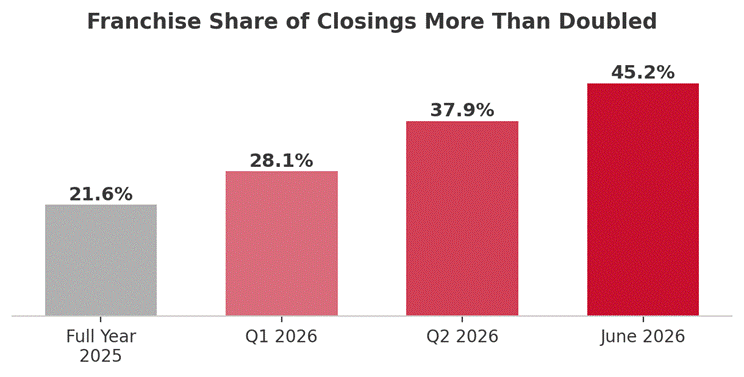
Franchise resales told a similar story of consolidation around lower risk. Their share of the firm's closings rose from 28.1% in the first quarter to 37.9% in the second and 45.2% in June alone — more than double the share franchises represented across all of 2025. Brands changing hands included Subway, Dairy Queen, Jimmy John's, Crumbl, Firehouse Subs, Charleys Philly Steaks, Smoothie King, Auntie Anne's and Captain D's, with several multi-unit portfolios trading, including a five-location Charleys group and a six-store Captain D's package.
The report attributes the surge to two forces meeting at once: buyers seeking bankable, proven systems in an expensive-money environment, and a wave of retiring baby boomer franchisees — what the report calls the "Silver Tsunami" — feeding a growing pipeline of transfers.
Fewer lookers, more serious buyers
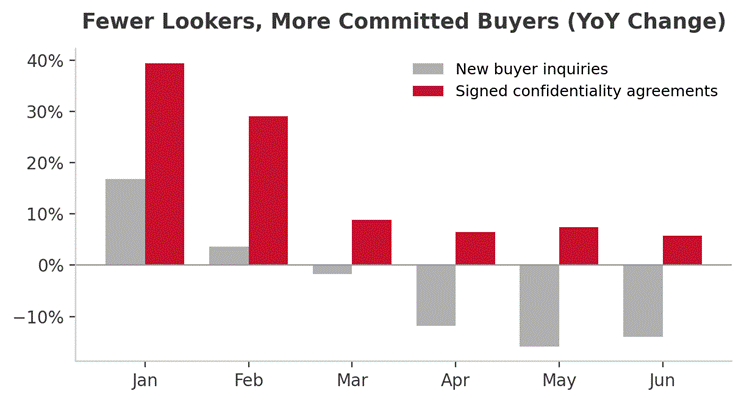
Buyer inquiries started the year hot, up 16.8% year over year in January, before a five-week stock market slide and gas prices topping $4 a gallon in March coincided with a pullback that held through June, when new inquiries ran 14% behind the prior year. Signed confidentiality agreements — the point at which a browser becomes a committed buyer — never went negative, finishing the half up 15.8% year over year. The report reads that gap as a funnel narrowing at the top and deepening in the middle: fewer casual shoppers, more buyers taking real steps toward a purchase. June, the softest month for new inquiries, produced the firm's largest closing month of the year.
What sold, and where
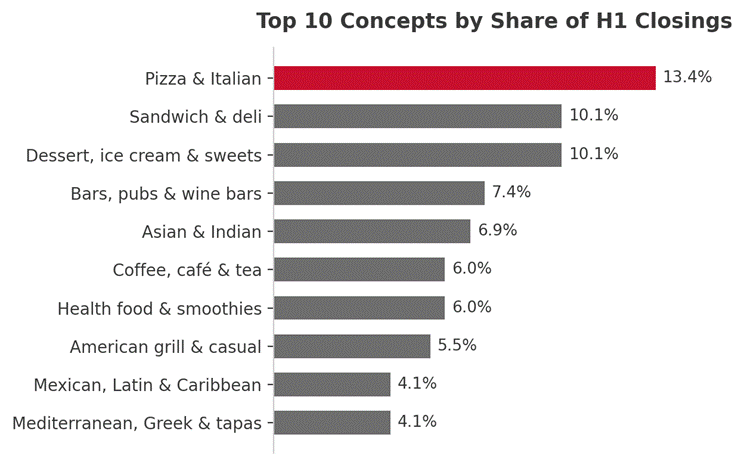
By concept, pizza and Italian restaurants led all closings at 13.4%, followed by sandwich and deli shops and dessert and ice cream concepts, each at 10.1%. Mexican and Asian concepts, despite ranking among Americans' favorite cuisines nationally, closed far less often — a gap the report attributes partly to thinner margins limiting how often those businesses transact. By service model, roughly six in 10 closings were limited-service operations, compared with fewer than four in 10 full-service restaurants, with quick-service closings carrying a median sale price of $115,000 against $183,000 for casual dining.
Geographically, the 11-state "Boom Belt" — Alabama, Arkansas, Florida, Georgia, Louisiana, Mississippi, North Carolina, Oklahoma, South Carolina, Tennessee and Texas — accounted for 83% of the firm's first-half closings and nearly nine in 10 signed confidentiality agreements by June. Florida remained the top closing state, while North Carolina led monthly buyer-interest rankings from February onward, with Charlotte and Nashville emerging as markets to watch in the second half.
Outperforming a shrinking market
We Sell Restaurants said its own closings grew 17.5% year over year in the first quarter and held flat in the second, against a national market that fell nearly 12% — a gap the firm attributes to specialization in a consolidating market. The company reports 1,375 active listings and more than $625 million in listing inventory, and said it plans to publish the market review quarterly, with the next edition covering the third quarter due in October.
Graphs: Courtesy of We Sell Restaurants
About Cherryh Cansler

Related Media
Featured Vendor

HungerRush brings every part of your restaurant together — orders, guests, data — in one platform built for fast casual and quick-serve multi-location brands ready to grow.
Subscribe
Get the latest news and resources from Fast Casual.
Recent Posts

Recent Podcasts