Technology
Rising costs, falling margins: Why restaurants must deploy workflows, not just robots
When operators start with the workflow, automation becomes easier to adopt and delivers results that are felt by both staff and customers, according to Elad Inbar, founder and CEO at RobotLAB.
April 27, 2026 | By Elad Inbar, founder and CEO at RobotLAB.
 ChatGPT
 Grok
Grok Perplexity
 Claude
The restaurant industry is operating under mounting pressure and market challenges. According to the National Restaurant Association, food costs have spiked 34% and labor costs have risen 39% compared to pre-pandemic levels. Labor shortages and employee turnover remain among the biggest operational challenges for owners across the country.
Now, layer in customer expectations. Operators are expected to deliver speed, consistency, and a high-quality guest experience, all while keeping menu costs in check. That is why robotics automation has moved from a nice-to-have to a necessity. It is no longer a question of if restaurants will adopt it, but how quickly they can scale it across their locations.
Driving consistency in an inconsistent labor market
There is a misconception that robotics in restaurants is about replacing staff. In reality, it is about removing the repetitive tasks that slow everything down. Every restaurant has a layer of work that is essential to operations but low value from a guest perspective. Running food. Delivering drinks. Transporting dishes. Scrubbing floors. These tasks consume hours every shift, and they take staff away from what actually matters: the interaction between your team and your guests.
Robots are being deployed to absorb that layer, and they are showing up in two main categories.
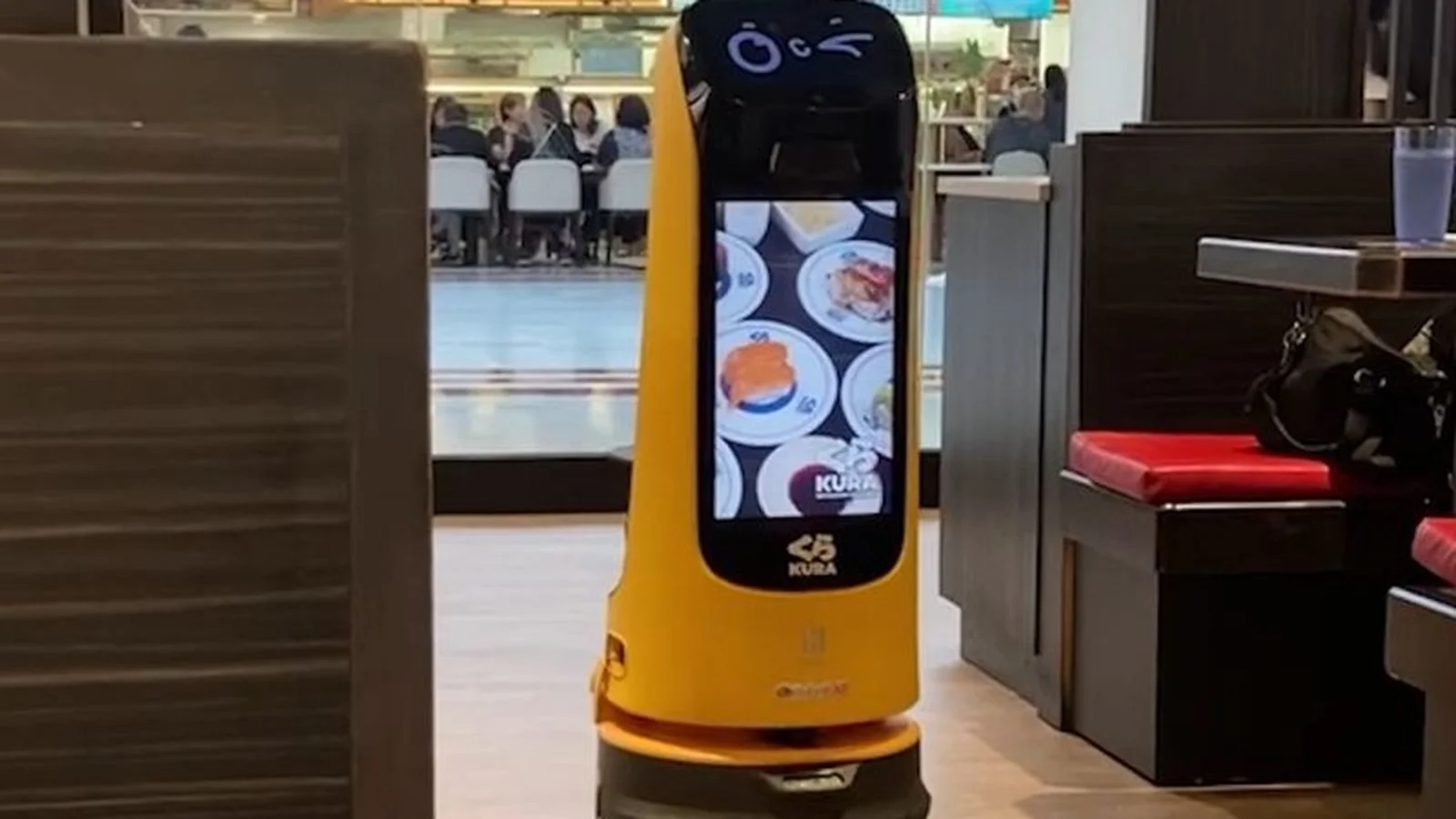
FoH:Delivery robots move dishes, drinks, and bussing bins between the kitchen and the dining floor. In high-volume environments, this alone can free up significant labor hours. Kura Sushi, for example, has active delivery robots deployed at more than 60 locations nationwide. Within months, the fleet has logging over 11,000 hours of operation per month, handling food runs during peak service so staff could stay focused on the guest experience.
BoH:Autonomous floor scrubbers are tackling a task that has historically been one of the least desirable in the building. Cleaning robots can run scheduled routes overnight or between shifts, maintaining hygiene standards consistently without pulling a team member off the line or the floor. For multi-unit operators, this adds up quickly: standardized cleaning across every location, every day, with no gaps during staffing shortages.
Both categories share the same principle. The robot handles the repetitive, physically demanding work. The staff handles the guest.
Deploy the workflow, not just the robot
The next phase of robotics in restaurants will be defined by integration. Restaurant leaders want solutions that are reliable and deliver consistent results, but early efforts have sometimes fallen short when businesses deployed robots without redesigning the workflows around them.
The reality is straightforward. You do not deploy a robot. You deploy a workflow. The robot is the tool that executes it.
When operators start with the workflow, automation becomes easier to adopt and delivers results that are felt by both staff and customers. Where does the robot pick up? Where does it drop off? How does it interact with existing service flow? Answer those questions first, and the technology becomes a natural extension of the operation rather than a disruption to it.
What comes next
Robotics gives operators a way to stabilize daily operations, protect service quality, and scale more efficiently. The shift is already underway across both full-service and fast casual environments.
For operators evaluating their next move, the starting point is not the technology. It is the workflow.
Related Media
Subscribe
Get the latest news and resources from Fast Casual.