Operations
3 restaurant growth deals, and what the new SBA rules change about each
A capital provider walks through three anonymized deals: A partner buyout, a franchisee whose tax return shows a loss and a ground-up build to show what SOP 50 10 8.1 actually changes for growing operators.
October 13, 2026
 ChatGPT
 Grok
Grok Perplexity
 Claude
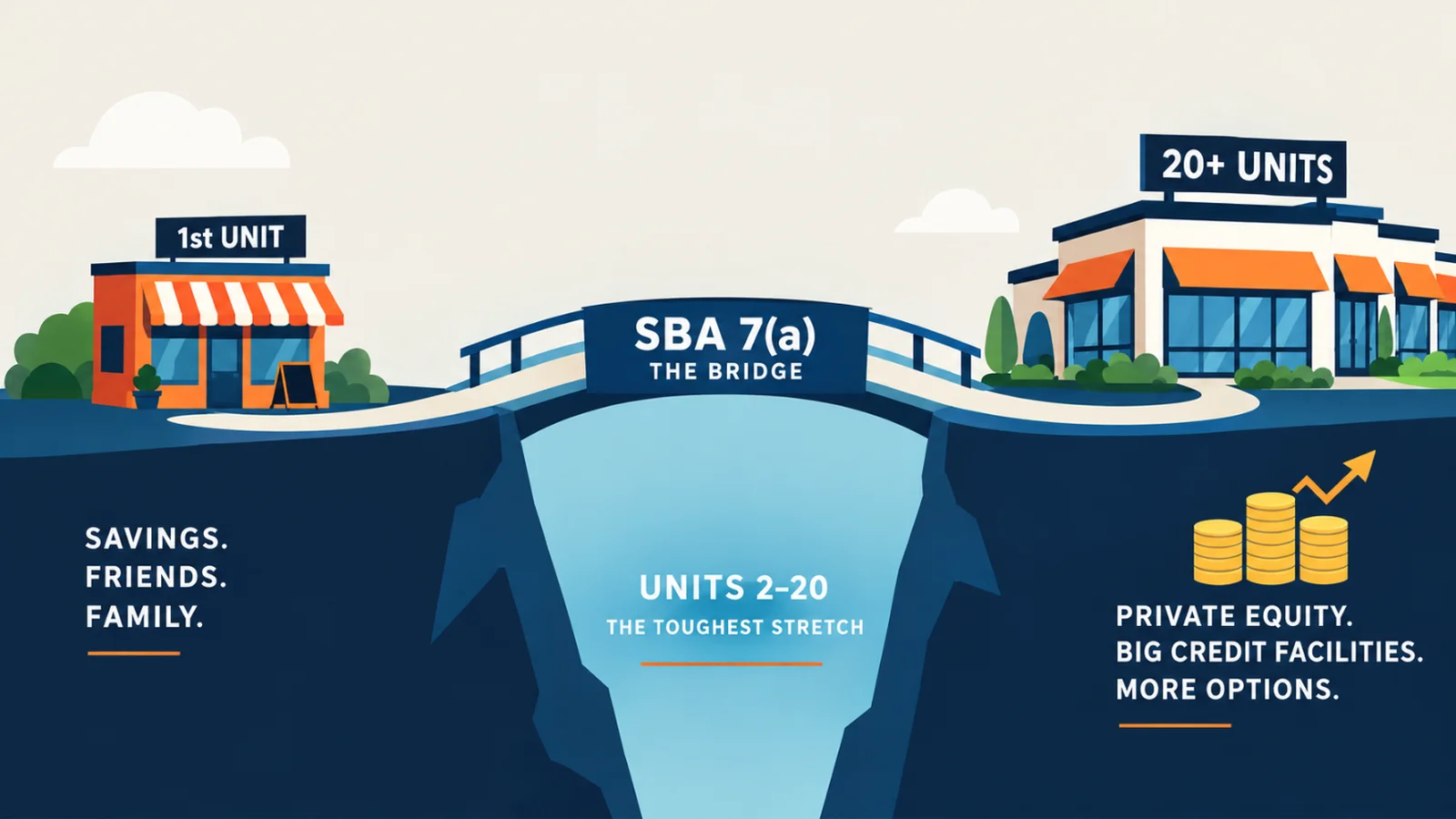
Every restaurant brand's capital journey has three phases. The first unit gets built with savings, friends and family. Somewhere past 20 units, private equity and big credit facilities start returning calls.
The hard part is the middle, units two through 20, where banks say "too risky," venture capital says "not software" and PE says "too small." For a lot of operators in that stretch, the U.S. Small Business Administration's 7(a) program has been the bridge.
On Oct. 1, that bridge got new rules. SBA's updated operating procedure, SOP 50 10 8.1, took effect. The short version:
- Buying an existing restaurant, buying out a partner, or acquiring another business now has to pencil out on historical earnings: the last fiscal year or the average of the last two. Minimum coverage is 1.25x for first-time acquisitions and owner buyouts, and 1.15x for an established business expanding by acquisition
- First-time and expansion acquisitions with a purchase price of $3 million or more need a lender-ordered quality-of-earnings report. A 10% equity injection is now the starting point even for expansion acquisitions. Money from passive investors now joins seller standby notes in a bucket capped at half of it.
- Any owner, even one below 20%, who has defaulted on SBA debt disqualifies the business.
- The SBA Franchise Directory is back, and franchisees of unlisted brands can't get SBA loans. We've met franchise systems that dropped off rather than materially change their franchise disclosure documents.
- Ground-up new units are still underwritten as startups, with projections and a 10% injection.
Here are three deals we've seen in the last few months, anonymized, with the numbers rounded.
The partner buyout
A five-unit Asian fast-casual group in Southern California is restructuring its ownership: two partners buying out a third for about $500,000, roughly $400,000 of it in outside cash. The two stores at the center of the deal do about $6 million a year combined at roughly 20% margins.
Under the new rules, this is an owner buyout: 1.25x coverage on historical earnings, plus a 10% injection unless the lender documents enough liquidity to reduce it. Their history covers the debt many times over.
These founders know the next two or three units will need capital too. SBA requires every owner with 20% or more to personally guarantee the loan, but most operators already guarantee their leases, business credit cards and most other debt, so that's rarely the deciding factor. The better question is how much capital they need and what their cash flow can support. If SBA is the only option, they'll have to meet the new rules. If they can handle shorter terms, other lenders will finance acquisitions and buildouts faster, at a higher cost.
The lesson: if your history is strong, the new rules probably aren't your problem. The real decision is whether you'd rather meet SBA's rules for the longer term or pay more for speed.
The franchisee whose tax return says it lost money
A drive-thru beverage franchisee with two open stores and five more leases signed has a flagship that did about $1.6 million in its first year and produces roughly $300,000 in EBITDA. Store by store, it's a healthy business.
On paper, it isn't. Aggressive depreciation, close to $1 million in a single year, pushed the consolidated books to a loss of more than $1 million. Add the depreciation back and the company is roughly break-even. Looking at global cash flow, the lender couldn't get comfortable enough to recapitalize the first store.
That was under the old rules. Now, if this operator wanted to buy an existing unit with SBA money, historical earnings are the only thing that counts toward coverage. And if the purchase price hits $3 million, an outside quality-of-earnings firm will be reconciling the cash.
The lesson: tax strategy and financing strategy are now the same conversation. If you might buy or sell in the next two years, your last two fiscal years are your loan application. Keep clean unit-level P&Ls, document every add-back, and get your CPA and your lender talking before you take the next big write-off.
The new build
A four-unit Mediterranean fast-casual group in Northern California needs about $800,000 for its next location, with roughly $200,000 of tenant improvement allowance from the landlord. They'd used an SBA loan on an earlier restaurant, at around 10%, and weren't eager to do it again.
This is the deal the new rules touch least. SBA still treats a ground-up unit as a startup, so projections still count. But lenders underwrite the whole group, not just the new store, and the ramp is where restaurant growth breaks. Across our portfolio and pipeline, first-year units run occupancy at 17% to 35% of sales, compared with 6% to 12% for mature units, and labor at 41% to 56%, compared with 23% to 30%. A new store loses money by design until it crosses a volume threshold. The operators who get hurt are the ones who open the next unit before the last one gets there.
The structure this group landed on: commit the capital before signing the lease, draw it when permits clear, and spread repayment across the existing stores and the new one while it ramps.
The lesson: financing the build is only half the job. Finance the ramp.
Before your next deal
- Check the directory. If you're a franchisee, confirm your brand is still listed.
- Treat your last two fiscal years as your application. For any acquisition, that's what the lender will underwrite.
- Count your equity sources early. At least half of the injection has to be your own unborrowed money or a similar source. Vet every investor for past SBA defaults.
- Watch the number that predicts survival. In our data, units whose prime cost plus occupancy stays under 80% of sales make money at least four times out of five. Above 80%, two out of three lose money.
The operators who keep growing through this won't be the ones with the best pitch deck. They'll be the ones whose books already tell the story.
Related Media
Featured Vendor

Our API-first platform empowers brands to own their digital ecosystem and scale profitably from end-to-end. By providing a flexible foundation for first-party digital experiences and seamless operational flow, we ensure every order, from web, mobile, or third-party, is fulfilled reliably.
Subscribe
Get the latest news and resources from Fast Casual.
Recent Posts



Recent Podcasts