Operations
Cava's Q3 miss hides a bet on larger dining rooms, half portions and value
A produce scare and gas prices slowed traffic, but the Mediterranean chain raised its sales outlook and laid out where it sees growth next.
November 6, 2026 by Cherryh Cansler — Publisher, FastCasual.com
 ChatGPT
 Grok
 Perplexity
 Claude
Editor's note: This is part 2 of a 2-part series, focusing on Cava's growth strategy. Part 1 covered Cava's investments in its general managers. Read it here.
Although Cava missed Wall Street's third-quarter estimates Wednesday, management raised its full-year sales outlook and used its earnings call to lay out a strategy that runs against several industry trends: investing in dining rooms, keeping a measured pace of menu launches and building a menu that wins in lower-income markets.
"While we are not immune to the environment around us, we are focused on what we can control, running great restaurants, delivering differentiated value through high-quality Mediterranean food and hospitality and continuing to invest with discipline in our teams and guests for the long-term growth," Brett Schulman, co-founder and CEO of Cava, said during the call. He also reaffirmed plans for at least 1,000 units by 2032.
Why Cava missed
Total revenue rose about 22% to $356.4 million, short of the $358.5 million analysts expected, according to Investing.com. Restaurant revenue was $353.7 million. Earnings of 11 cents per share missed the 12-cent consensus, and adjusted EBITDA of $42.3 million trailed the roughly $44 million FactSet estimate cited by Telsey. Shares fell about 11.5% in after-hours trading.
The main problem was traffic. Same-restaurant sales grew 3.1%, below the roughly 3.6% analysts expected, a sharp slowdown from 9% in the second quarter and 9.7% in the first, according to the company's earnings releases. Traffic, which drove 5.3 points of growth in Q2, was only slightly positive in Q3; nearly all of the gain came from price and mix.
Cava pinned about 150 basis points of the slowdown on Cyclospora and wider consumer worries about fresh produce early in the quarter. Then gas prices spiked after Labor Day. Schulman said both pressures hit the whole category, that trends strengthened as the quarter closed and that the improvement carried into October.
The second problem was margin, and that one was largely by choice. Restaurant-level margin fell to 23.4% from 24.6% a year ago. Labor rose 50 basis points to 26% of revenue, other operating expenses rose 70 basis points on a higher third-party delivery mix and repairs, and preopening costs jumped to $8.4 million from $4.9 million.
Cava raised its full-year same-restaurant sales outlook to 6% to 7% and now expects 76 to 78 net new openings. It trimmed its margin range to 23.7% to 24% and raised preopening guidance to $28.5 million to $29.5 million.
The dining room still pays
Schulman said while many brands are shrinking dining rooms, Cava is going the other way. Its Project Soul design uses warmer tones, greenery and natural light, and a new program, Project Sun-Kissed, brings those elements to older restaurants through remodels.
At one urban test location, dinner sales rose 18% after the Sun-Kissed remodel, said Schulman, adding that guests who use both digital and in-restaurant channels visit 3.3 times as often.
"I've been on record for years saying the demise of the dining room is greatly exaggerated," he said.
Why shrimp may outsell salmon
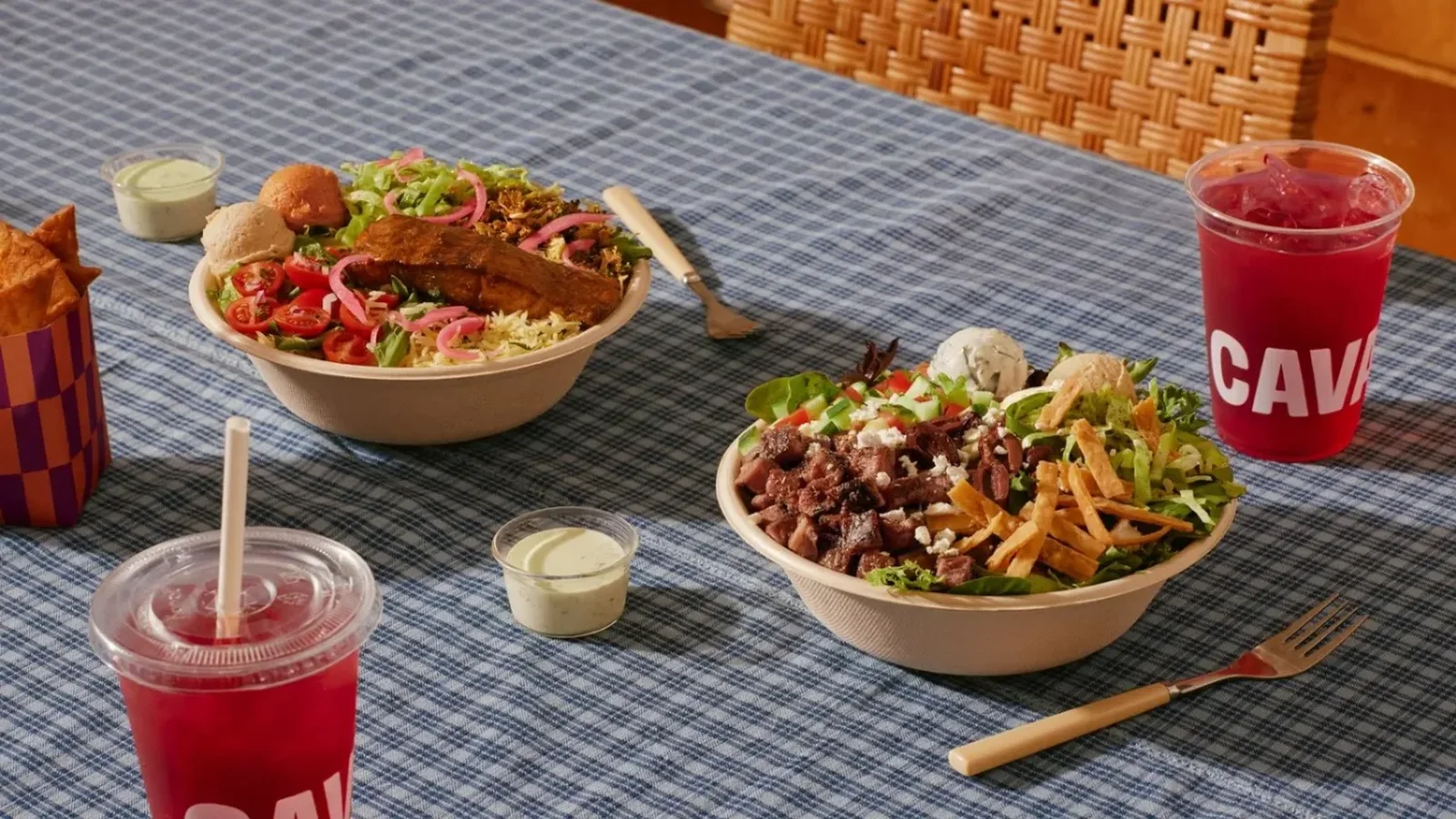
Cava's pomegranate-glazed salmon, launched in April, performed in line with expectations and will stay on the menu through spring instead of ending this year. Schulman shared a lesson, however: The 4-ounce fillet is the one protein guests can't split into a half-and-half bowl, a favorite move at Cava.
Shrimp can be split, and Schulman said that is driving faster adoption in testing. Cava has finished testing roasted garlic shrimp and will share national rollout timing next quarter. White sweet potato, which also sells heavily as a half portion, returns in January.
Schulman also said Cava is keeping its limited-time offer pace in check so it doesn't overload operators, noting that LTOs across the industry have roughly doubled in recent years.
Lower-income markets are leading
Cava's strongest same-restaurant sales are coming from restaurants in markets with lower median household incomes, and the growth there is mostly transactions, Tolivar said.
"Ironically, we're also seeing in the lower income cohorts of our restaurants that they're indexing higher on premium protein attachments, which is a little counterintuitive," she said.
She credited a "barbell" menu. The entry bowl costs $10.65 in many markets and includes chicken, falafel or roasted vegetables plus unlimited toppings, while premium proteins give guests a way to trade up.
Catering and loyalty are next
Cava launched a second catering market test in the past couple of weeks using a hub-and-satellite model, where only some restaurants produce catering. Its Houston test has every restaurant producing catering. Schulman said the company expects to settle on a chainwide approach early next year.
Cava is also moving to a new loyalty platform next month. That sets up a third phase of its program, expected over the next 12 to 18 months, built around personalized offers that push guests up its status tiers.
About Cherryh Cansler

Related Media
Subscribe
Get the latest news and resources from Fast Casual.
Recent Posts
Recent Podcasts