Article
Drawing them to dinner
Business during the dinner daypart is perking up with dinner-specific entrees.

June 6, 2007
 ChatGPT
 Grok
Grok Perplexity
 Claude
Hoping to draw a wider range of customers, Bear Rock Café launched an initiative two years ago to "evolve" its menu. Primordial stew wasn't among its chefs' new offerings, but the half dozen dishes that made it to the final menu signaled Bear Rock was on the prowl for new business among the casual-dining customer base.
From 4 p.m. to close daily, the mostly breakfast-and-lunch-focused chain now sells substantial entrees such as Meatloaf Marsala, 3 Hour Pot Roast and Chicken Pot Pie at a single unit in its hometown of Cary, N.C. Dinner diners craving seafood can cast for Grilled Mahi Mahi (with pineapple-mango salsa) and Crab Cake & Fire Grilled Shrimp.
Most interesting, however, is the cost of some of those entrees, some as high as $13.49 — well above the segment average of $7 to $9 per meal.
Deneen Nethercutt, vice president of marketing for Bear Rock Services, owner of the 34-unit chain, said the new menu is but one facet of an ongoing development plan for the chain.
"Our brand has never been just a sandwich shop," Nethercutt said. "This is part of the whole development process of our brand and a natural offshoot of that."
And, arguably, a shot across the bow of its casual-dining counterparts, though Nethercutt said the company isn't specifically targeting that segment's customers. What Bear Rock does see is an opportunity to grab new business by addressing operational shortcomings in other restaurant segments, she said.
"We know how fast casual evolved out of the unfilled niche between quick-service and casual dining," she said. "So we've asked ourselves: How can we maximize our strengths ... and effectively differentiate ourselves from our competition?"
The answer: Provide true dinner items and enhanced service not commonly found in fast casual. (At Bear Rock's test restaurant, food is delivered to customers' tables, but tips are not necessary.)
Fast-casual operators always have wanted to increase dinner sales, but creating menu items specifically targeted to the evening daypart shows an emergence of more focused efforts. Panera Bread Co. has made a similar move with its Crispani (pizza) lineup and Grilled Salmon and Bistro Steak salads. And menus at Texas-based chains Café Express and Le Madeline bear a few $10 entrees.
Beverages are getting a bump up, too. Le Madeline recently rolled out a wine program that includes six varietals sold in carafes holding one-and-a-half glasses of wine. C.O. Jones, a fast-casual Mexican restaurant in New Haven, Conn., sells high-end tequilas and innovative margaritas to its burrito-buying patrons.
"We serve 25 different margaritas and 15 different tequila samplers," said Bob Potter, founder of C.O. Jones. Entrees there cost around $7. "We sell a large (house) margarita for $8, and a premium small for $6 to $7. A large premium is in the $10 to $11 range. We like to think of ourselves as a grown-up Chipotle or Baja Fresh."
Case of mistaken identity?
Darren Tristano, executive vice president at Technomic Information Services, said driving dinner sales is challenging for fast casuals. Strategies vary from running the same menu all day long to creating new options specifically geared for dinner. Giving patrons a reason to return at night requires a restaurant to offer variety that reflects its core identity.
| ||||||||||||||||||

"I'm a big fan of Bear Rock, but I think it's probably a stretch that it could prove itself in the breakfast and lunch dayparts like it has, and then generate sales in the dinner daypart with more expensive items," Tristano said. "It'll be a challenge for them to convince the customer that this is, in essence, a new place for dinner."
A sticking point for Tristano is price; he believes fast-casual customers are comfortable with the quality of food and service they get within the common $7 to $9 range. Convincing them to spend more than $13, he said, could be tough.
"What Panera has done to add Crispani makes perfect sense in this argument," he began. "A $6 or $7 pizza does not put them outside the range of what customers normally spend there. But when you start to get into the range of $8 to $15 in price, you have to change customers' behavior. ... When I think about something like C.O. Jones, I think, 'Grab a burrito and a beer and go.' I'm not thinking about high-end tequila."
Trends tracker Suzy Badaracco views fast casual's menu upgrading trend as positive and reflective of similar trends developing in other retail sectors.
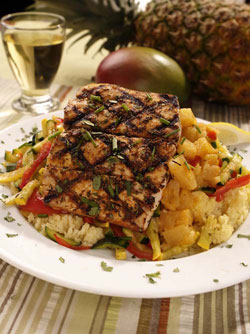 |
Bear Rock's new Grilled Mahi Mahi |
"This trend is what I call a category crossover," said Badaracco, president of Culinary Tides. "This is where a restaurant has a certain set price point and menu items, and it's trying to cross into another category and take business from a different restaurant with higher price points and a different clientele."
Badaracco pointed to Starbucks' recent addition of breakfast sandwiches as one example. The coffee company saw the growth in breakfast consumed away from the home, and it seized the opportunity to pair morning foods with its coffees.
Fast casuals already serve food at breakfast and lunch, so why not tweak their concepts to extend sales into the evening?
"There's no reason you can't reinvent yourself and your concept," she said. "It may sound strange to look at it this way, but look at Madonna; she reinvents herself every few years. U2 does the same. And in many industries, if you don't reinvent yourself now and then, you could be dead in the water."
Tristano agreed that reinvention can be a good thing as long as the concept maintains its recognized image in the customer's mind. He said that over several decades, McDonald's has retooled and retuned its concept successfully to adjust to consumer demand, especially at breakfast. But throughout that evolution it never drifted from its core concept.
"Just because steaks are popular, you don't expect to see McDonald's selling them at dinner," Tristano said. "But they've recognized that big burgers are in now, so they're adding those to the menu."
Adapting to change is wonderful, Tristano added, especially when it's profitable to the operation. Panera's Crispani addition, he said, fits in well with the chain's product line because it's a fresh-baked bread product. Few operational changes were required to add it, and the boost in sales more than offset the cost of added training and labor required for execution.
"If you do one thing well, keep doing it," he said. "If you try to change what that is just to match the competition, you risk diluting the brand."
Make it substantial
Several months since its new dinner menu launch, Nethercutt said Bear Rock's Meatloaf Marsala is the new group's top seller — not surprising in a country where, according to the USDA, the average person eats nearly 70 pounds of beef annually. Beef is, in many cases, what's for dinner, not only at Bear Rock, but at other fast casuals and on sandwiches and in salads. But at Le Madeline, it's swaddled in crepes or bathed in a savory stew.
Salmon has swum on to many a menu as well, in salads and in sautéed dishes with richly herbed cream sauces. The proliferation of farm-raised salmon has made the fish easily recognized by customers, but highly affordable and profitable for operators.
What's clear is customers want substance at dinner, and operators like Le Madeline are providing it with bundled meals including one to two side items. According to the chain's senior director of marketing, Hal Gronfein, Le Madeline offers sides such as green beans amandine, garlic mashed potatoes and rice Provençal.
Hoping to drive sales to couples, Le Madeline also sells two-for dinners for $19.99 every night, Monday through Friday.
"For example, we sell two Chickens Le Madeline and give guests a choice of soup or salad for two and a baguette to share for $19.99," Gronfein said. "We offer a different selection each night, such as chicken pesto pasta on Tuesday."
Operators also are bumping up guest service by delivering dinners — which in some cases take longer to prepare — to guests at the table. Nethercutt said Bear Rock guests enjoy the added touch, especially since tipping isn't expected. The chain also began using plateware and silverware in its test restaurant.
"Fast casual presents the benefit of having a wide range of high-quality food options and a high level of service," Nethercutt said.
And that's the trick operators must master, Tristano said: providing a lot of options and great service, but managing the costs that come with those features.
"When you can keep your fixed costs the same while doing more stuff in different dayparts, that's when you become highly profitable," he said. "That's where (new dinner items) can have a real impact."
Related Media
Food & BeveragePresented ByOracle
Presented ByOracle
Subscribe
Get the latest news and resources from Fast Casual.