Article
Billboards draw fast-casual customers
This traditional form of advertising has changed, but still effective.

September 18, 2006
 ChatGPT
 Grok
Grok Perplexity
 Claude
Despite the boom in electronic media advertising, billboards remain one of the most effective forms of advertising. Marketers spend an estimated $5.5 billion a year on outdoor ads in the United States, according to the Outdoor Advertising Association of America.
"Bottom line, outdoor signage builds awareness through low-cost multiple impressions, reinforcing your other advertising media," said Bryan Theis, director of field marketing for FASTSIGNS, an international sign-making firm.
A prime example is Chick-fil-A, with its famed, nation-wide billboard campaign depicting cows writing the words "Eat Mor Chikin." The campaign has been in use since 1995.
"You see those Chick-fil-A billboards and your eyes just stop," said Peter Koeppel, founder and president of Dallas-based Koeppel Direct, a full-service marketing firm. "Their messages and images are instantly recognizable."
The same can be said of Blake's Lotaburger, a New Mexico chain with a quirky personality. What started with radio spots, the chain's "It's a Lotaburger, But You're a Lotaman" ad campaign now appears on billboards throughout its home market.
"Knowing if billboards are right for you is determined by who your clients are and how they will respond to certain situations," said Bart Cleveland, partner and creative director at Albuquerque-based McKee Wallwork. "Will they respond to outdoor? Are they exposed to outdoor at the right times? Billboards are almost a point of sale for Lotaburger because of the proximity that they're posted, on small highways and thoroughfares where stores are located."
High-tech creativity also has contributed to billboards' popularity, from scrolling messages to alternating ads. If desired, digital billboard ads can change by the minute at little cost.
Not only is billboard digitization new, so are pricing structures that make billboard advertising more attractive to media buyers. Renting a static billboard in New York can cost up to $40,000 a month, according to CBS Outdoor; purchase one outright on roads less traveled and you're out $70,000.
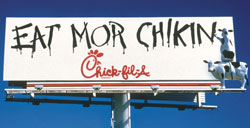 |
Chick-fil-A's billboard campaign is considered to be one of the top campaigns of all-time. (Photo provided by Chick-fil-A) |
In Toledo, Ohio, rates range from $7,200 to $11,200 a month, which is double the cost of standard billboards in that market. Divvy the cost six ways on an alternating-image digital billboard, and an advertiser pays as little as $1,200 a month.
Visual cues, old and new
According to the Direct Marketing Association, using photos in outdoor advertising creates a 300-percent greater recall than ads without photos. Also, a colored background organizes the information and enables the viewer to read it 26-percent faster, according to the Pennsylvania College of Optometry.
"Billboard advertising works and it works very well, if it's used properly," said Cleveland. "High-quality graphics are critical. One of the great things for fast casuals is that the technology for printing outdoor graphics is photographic. It's like product packaging — you have to have an appetizing photograph."
Cleveland added that billboards can fail when an advertiser tries to do too much. "So many times billboards are ineffective because we try to use them to communicate more than they can communicate, or to communicate too complex an idea. It takes too long for a person viewing the billboard to understand the message."
An example is a sign plastered with a number of Web site addresses, phone numbers and logos. Too much of a good thing has the wrong effect when passers-by have seconds to read as they speed past.
For a billboard to maximize its per view potential, Cleveland suggests first determining what the ad needs to accomplish.
"There are certain products or services that may not benefit that well from outdoor advertising," said Cleveland. "A branding message that isn't complicated works the best."
Cleveland warns against a message that grows stale. Depending on the location of the billboard, most target consumers see a billboard's message continually — on their way to and from work, for instance. Constantly refreshing messages is the solution to keeping the billboard from being ignored.
Measuring exposure
Static billboards still make up about 60 percent of the approximately 400,000 billboards in the United States, according to the Outdoor Advertising Association of America. Historically, tracking performance of the advertising on these billboards has been near impossible.
"Whether an image or branding from a billboard translates into sales is questionable," said Koeppel. "You can't actually determine how well the advertising works like other direct-response mediums can, such as direct mail or online offers. It's really a mass-audience medium."
Billboard effectiveness tracking is happening. Some messages direct consumers to a Web site or even text-messaging codes in an effort to track success. An Absolut vodka billboard in Times Square, for example, lets passers-by with cell phones text message the code for a free Lenny Kravitz song download. Absolut tracks the number of downloads, thus measuring the exposure and interest in the ad.
The need for direct response prompted the Outdoor Advertising Association of America to initiate a three-year, $10 million-plus project to develop audience measures that give advertisers better data about who sees their ads.
The study showed that those most likely to see an outdoor sign were, among men, those aged 35 to 54, and among women, 18 to 34. Exposure to outdoor ads peaked during the commuter rush.
Related Media
Subscribe
Get the latest news and resources from Fast Casual.
Recent Posts

'Stuff it': Panera Bread introduces bread rolls filled with salads

Deliverect AI debuts autonomous workforce to manage menus, protect digital revenue
Fluffy Fluffy Cafe launching US growth plans

Saucy by KFC adds Drips by Pepsi beverages to menu

PAR Technology launches PAR Intelligence AI Platform for multi-unit operators