Food & Beverage
Why the 'new' food pyramid is choosing opinion over evidence
Suzy Badaracco's imagined dialogue between a registered dietitian and the personification of whole grains reveals how the "inverted" government food pyramid lacks scientific justification and threatens both public health and consumer trust.
January 19, 2026 by Suzy Badaracco — President, Culinary Tides Inc
 ChatGPT
 Grok
Grok Perplexity
 Claude
ACT I — THE UPENDING
SETTING: A fast casual bakery after closing.
Menu boards flicker as new panels are tested. A stack of discarded printouts reads "UPDATED MENU – SIMPLIFIED."
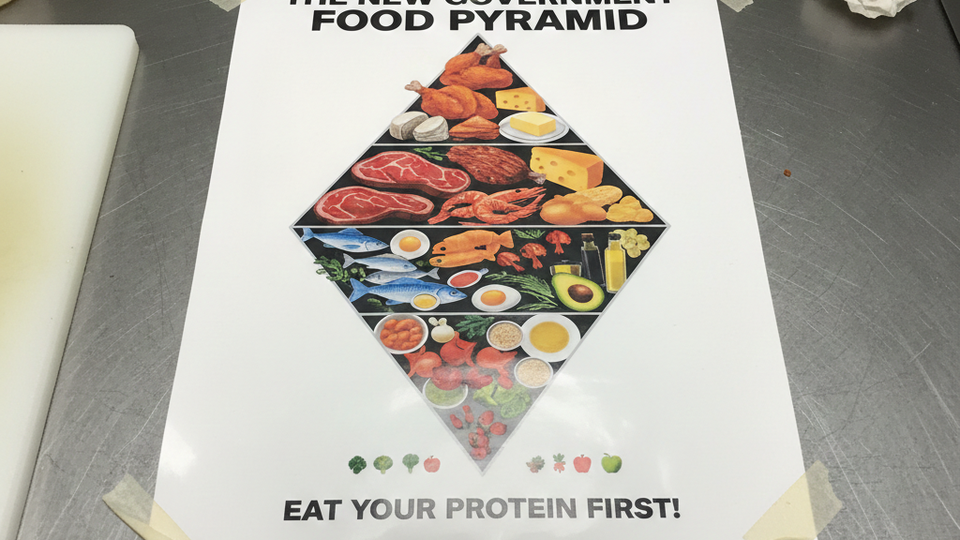
A laminated image of the new inverted government food pyramid is taped to a stainless prep table, corners curling.
On one side stands WES WHEATMAN, the embodiment of whole grains. Behind him are clear jars labeled Oats, Barley, Brown Rice, Farro, Whole Wheat. His presence is solid, unembellished—built for endurance, not trend cycles.
Across from him stands DANA DIETMAN, RDN, flips through menu mockups, frustration visible. She is a dietitian trained in public health, accustomed to translating complexity—but visibly unsettled.
DANA DIETMAN, RDN
(staring at the pyramid)
I've been through guideline updates before. This one feels different.
WES WHEATMAN
Different how?
DANA DIETMAN, RDN
They didn't challenge you. They didn't introduce new outcomes.
(pauses)
They emphasized your role, yes, but then they just downgraded your importance in the diet.
WES WHEATMAN
Position carries meaning.
DANA DIETMAN, RDN
Exactly. Visual hierarchy becomes nutritional judgment, whether that was the intent or not. You didn't lose relevance—you lost placement.
(She gestures to the projection.)
And there's no new body of evidence that justifies it. There wasn't a new meta-analysis. No reversal in long-term outcomes. Just a redesign.
ACT II — CONSUMERS DIDN'T ASK FOR THIS
DANA DIETMAN, RDN
What makes this worse is that consumers aren't moving away from whole grains.
According to Mintel, nearly three-quarters of U.S. consumers say they believe they should be eating more whole grains. Not experimenting. Not reconsidering. Intentionally increasing. For decades, dietetics research has shown whole grains support fullness and steadier energy—not weight-loss fads.
WES WHEATMAN
That's conviction.
DANA DIETMAN, RDN
And it's reinforced by Circana's consumer behavior research. They show over two-thirds of shoppers actively read ingredient lists, with whole grains acting as a trust marker—linked to satiety, digestive health, and "real food" credibility.
WES WHEATMAN
So while guidance visually demotes me, consumers are leaning in.
DANA DIETMAN, RDN
Yes. Policy is moving against consumer momentum, not with it.
ACT III — THE ALLIANCE PROBLEM (WHOLE GRAINS + FORTIFIED FLOUR)
(Dana's frustration sharpens.)
DANA DIETMAN, RDN
What I can't ignore is the false binary this creates.
WES WHEATMAN
Whole grains versus refined flour.
DANA DIETMAN, RDN
When in reality, they've always functioned together.
(She gestures to a placard labeled Fortified Flour.)
According to the Centers for Disease Control and Prevention, mandatory folic acid fortification led to a 35 to 50% reduction in neural tube defects, including spina bifida. That intervention saved lives—at scale. The CDC continues to support fortification because nutrient gaps don't disappear just because narratives change."
WES WHEATMAN
And I was never meant to replace that.
DANA DIETMAN, RDN
No. You complement it. Fortified flour addresses a population-level micronutrient gap. Whole grains deliver fiber, minerals, phytochemicals, and metabolic stability.
(She exhales.)
DANA DIETMAN, RDN
Shunning fortified flour to "clean up" the diet narrative ignores one of the most effective public-health wins we have. And shrinking whole grains weakens the alliance that made both successful.
ACT IV — GUT HEALTH CAN'T SURVIVE A DEMOTION
WES WHEATMAN
They still talk about gut health.
DANA DIETMAN, RDN
They talk about it without anchoring it.
WES WHEATMAN
Research from the University of Minnesota shows that whole grains are among the largest contributors to dietary fiber intake in the U.S. diet. And yet, more than 90 percent of adults fail to meet recommended fiber levels.
DANA DIETMAN, RDN
Which tells us the problem isn't excess—it's insufficiency. And visual demotion doesn't correct insufficiency—it reinforces it.
WES WHEATMAN
Fiber fuels prebiotics. It supports microbiome diversity. It stabilizes glucose metabolism.
DANA DIETMAN, RDN
And according to Mintel's health and nutrition research, fiber has re-emerged as a top consumer priority precisely because of its role in gut, metabolic, and immune health.
WES WHEATMAN
You can't promote gut health while marginalizing its main input. We've known for decades people don't get enough fiber. Moving me lower doesn't fix that.
DANA DIETMAN, RDN
Not without undoing years of education.
ACT V — PLANT PROTEIN LOSES ITS PARTNER
DANA DIETMAN, RDN
There's another consequence no one seems eager to address.
WES WHEATMAN
Plant-based diets.
DANA DIETMAN, RDN
Yes. According to ADM's global protein research, four out of five consumers believe plant proteins support healthy aging.
WES WHEATMAN
Belief doesn't ensure adequacy.
DANA DIETMAN, RDN
Exactly. Dietetic research consistently shows that protein complementation—grains combined with legumes—is essential for meeting essential amino acid needs in vegetarian and plant-forward diets.
WES WHEATMAN
Grains don't compete with other plant proteins.
DANA DIETMAN, RDN
They complete them. Shrinking whole grains makes plant-based eating harder to do well, not easier. When grains shrink, protein adequacy becomes harder for people who already think they're "doing it right."
ACT VI — WHAT THE PYRAMID DOESN'T SEE
(The room grows quieter.)
DANA DIETMAN, RDN
They'll say this simplifies guidance.
According to Innova Market Insights, when foods are visually deprioritized, consumers interpret that as avoidance, not moderation.
WES WHEATMAN
Structure becomes instruction.
DANA DIETMAN, RDN
And nuance disappears downstream—especially in a media environment that favors absolutes. Consumers don't downshift—they drop categories entirely, and menus feel the impact.
WES WHEATMAN
Then the wrong lesson gets learned.
ACT VII — RECLAIMING CONTEXT
WES WHEATMAN
So I'll ask the question the pyramid doesn't.
DANA DIETMAN, RDN
Go on.
WES WHEATMAN
What problem did emphasizing, but then shrinking, whole grains actually solve?
(Dana closes her laptop.)
DANA DIETMAN, RDN
None that the evidence supports.
(She looks back at the projection.)
DANA DIETMAN, RDN
Whole grains belong at the center. Fortified flour belongs beside them. Nutrition works in alliances—not silos.
WES WHEATMAN
This wasn't about science.
DANA DIETMAN, RDN
It was about opinion.
ACT VIII — INDUSTRY, TAKE NOTE
(The screen dims. Dana Dietman turns from the glowing pyramid, facing an unseen audience—representatives of the food industry seated in quiet anticipation.)
DANA DIETMAN, RDN
I know this shift has left many of you unsure how to adjust. You're asking: Do we follow the pyramid? Do we change menus? Do we wait?
Here's my advice—straight from the evidence:
- Stick with the science. Despite this redesign, whole grains still promote satiety, gut and metabolic health, and long-term wellness. That hasn't changed. Keep offering balanced meals with grains as foundational—not ornamental.
- Balance beats binary. Don't frame this as whole grains versus refined. Remember the fortified flour alliance. Both are public health wins. Let your menus reflect their complementarity.
- Educate through design. Use your menus as a form of guidance. Highlight how certain ingredients work together—grains and legumes, for instance—to meet nutritional goals. Help consumers learn by showing relationships.
- Offer context, not absolutes. Emphasize proportionality, not elimination. Design offerings that reflect moderation, not restriction. That's how people sustain healthy choices.
- Respond to momentum, not just policy. Consumers want whole grains. They're buying them, reading labels for them, and trusting them. Let consumer conviction—not shifting graphics—guide your innovation.
- Be a guide, not a gatekeeper. Don't pull back from grains. Lean in—with clarity, with balance, with science. You have a platform. Use it to support informed decisions.
(She lowers the notes. A pause.)
You don't need to rewrite your menus. Just keep writing them with purpose.
(The lights dim further. Wes nods from across the room. The pyramid fades to black—if only for a moment.)
FADE OUT
Closing line:
When guidance shifts without evidence, consumers don't lose trust in food — they lose trust in who gets to decide what's true.
About Suzy Badaracco

Related Media
Food & BeveragePresented ByOracle
Subscribe
Get the latest news and resources from Fast Casual.