A View From The Top
Why Dog Haus hearts virtual kitchens (and why you should, too)
Nearly 18 months ago, Dog Haus started developing virtual brands for an August 2020 launch, but COVID-19 forced an earlier debut. Dog Haus' Hagop Giragossian explains how that decision is fueling the brand's growth.
August 31, 2020
 ChatGPT
 Grok
Grok Perplexity
 Claude
By Hagop Giragossian, partner, Dog Haus
About 18 months ago, Dog Haus started developing virtual brands for an August 2020 launch, but when the COVID-19 crisis forced dining rooms to close across the country, it was clear we needed to react quickly to keep our franchisees in business and their team members employed. This resulted in accelerating our timeline to immediately implement our unique strategy. During an unprecedented and challenging time for the industry, most brands leaned into delivery and some went further by leveraging virtual kitchens to drive business. We were already well-positioned within the third-party delivery space, as well as having begun a program of opening virtual restaurant locations with partners Kitchen United and CloudKitchens. In addition to expanding our number of virtual kitchens, we also introduced new profit centers directly into our current Dog Haus business model. This immediately offered existing franchisees multiple opportunities for success in a trying time and beyond.
 |
| Dog Haus' Hagop Giragossian |
An early start
We were exposed several years ago to the traditional virtual kitchen model, which gives restaurants the opportunity to maximize delivery coverage without the upfront investment needed for a brick-and-mortar location. Its appeal was immediate, and we began the process of planning, creating relationships with virtual kitchen partners and finding operators that could help us launch a virtual kitchen program for Dog Haus.
While the traditional model is great, Dog Haus is anything but traditional. Through our first virtual kitchen location, we learned the platform also would work in a standard brick-and-mortar, ultimately leading us to the idea of spinning off popular items from our menu into brands of their own.
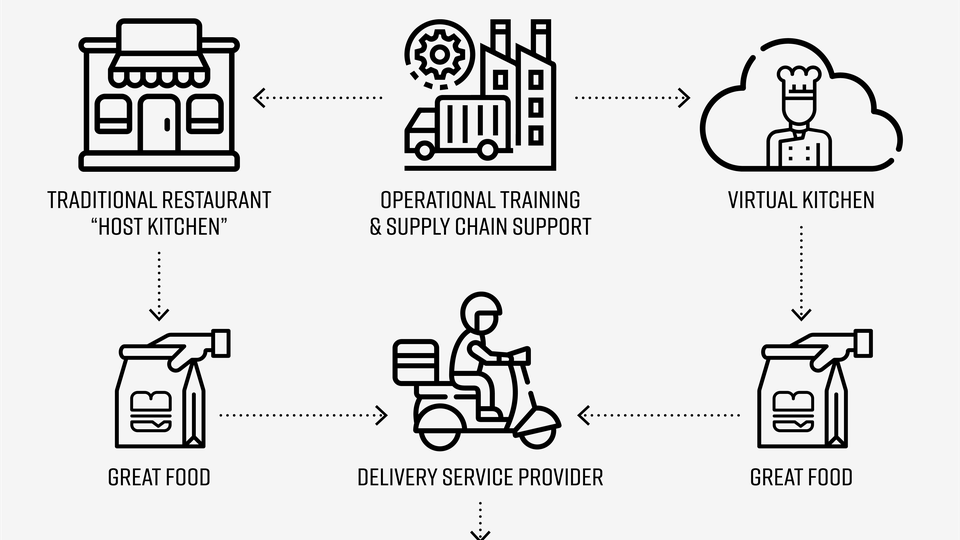
So, instead of just staying in the virtual kitchen space, we explored the virtual concept space with the birth of The Absolute Brands — a restaurant group comprised of Dog Haus and eight unique brands. The pandemic put us in a position to accelerate our launch plans to March 2020, more than four months earlier than planned. We started by introducing three delivery-only concepts — Bad Mutha Clucka, Plant B and Bad-Ass Breakfast Burritos — at virtual kitchen locations and most of Dog Haus' brick-and-mortar locations. New and existing franchisees now have the opportunity to either operate a kitchen space out of a Kitchen United or CloudKitchens facility, or they can use a current location to serve The Absolute Brands' delivery-only concepts, which we're calling host kitchens.
Below are three reasons why the virtual kitchen model can help restaurants reach wider audiences:
1. The virtual kitchen model offers more revenue streams than ever realized.
Virtual kitchens taught us that you can operate anything from anywhere. Dog Haus franchise partners operate a brick-and-mortar location as part of their franchise agreement, but we give them the option to maximize their delivery coverage by either opening a virtual kitchen space in a separate facility or adopting the host kitchen platform or both.
All three options — standard brick-and-mortar, virtual kitchen and host kitchen — offer convenience for guests who choose to order their favorite items through a major third-party delivery service provider and have them dropped off where they are and when they want it. The virtual concepts provide substantial data, allowing us to continually optimize our offerings in every market, creating menus tailored to satisfy each community's unique demand.
Through our host kitchen platform, Bad Mutha Clucka, Plant B and Bad-Ass Breakfast Burritos have driven significant revenue for Dog Haus' corporate and franchise locations, which has helped us offset the declines experienced when dining rooms were closed. Dog Haus franchisees are now reporting increased sales. Even more, we're stoked to report that some underperforming locations are now in the top 10 restaurants brand-wide.
2. Virtual kitchens and host kitchens amplify returns of third-party delivery.
Because virtual kitchens give us the opportunity to bring Dog Haus' unique chef-driven menu items to consumers, whether or not there is a physical restaurant near them, our market segment has expanded significantly. Through The Absolute Brands, we're able to offer multiple restaurant options within one space, whether that space is in a virtual kitchen or a host kitchen. This really leverages every square inch and boosts the box economics.
In 2019, the average person used a food delivery app three times per month, and 31% of consumers say they order food through a third-party delivery service at least twice a week. Those numbers have doubled during the current crisis. Pre-pandemic, delivery accounted for 30-40% of our sales. Now, that percentage has jumped to 60-70% for our brick-and-mortar locations that are open for dine-in because we added virtual concepts to our restaurants.
3. Virtual kitchens allow you to test individual items, whole menus and entire markets quickly, easily and economically.
In the traditional model, item and menu testing happens slowly and behind the scenes, while market testing requires full-court press marketing support and significant investments in time to develop the data necessary for evaluation. With our virtual kitchen strategy, we've bypassed those hurdles. The immediacy of the virtual space, its inherent integration with social media and third-party delivery, along with the significant amount of data generated by digital business combine synergistically. This has allowed Dog Haus and The Absolute Brands to pivot almost immediately when it's in our best interest.
For us, it begins with Dog Haus Würstmacher and Culinary Director Adam Gertler, who operates our Innovation Kitchen, located inside a CloudKitchens facility in Hollywood. Together, we are able to brainstorm new ideas and quickly test them in his kitchen. Once new recipes and items are developed, they get posted on social media and select third-party delivery apps. If they develop traction, we measure their performance by both day parts and geographic demand. When a new item has tested well, it quickly gets rolled out to our other locations, be they virtual or host kitchens.
In today's consumer climate, we recognize the virtual kitchen model's efficiency has significant appeal to all brands, but by creating an integrated virtual kitchen strategy, we've taken virtual kitchens up several levels. We want to continue innovating throughout the entire dining experience space. In order to do that, we must continue doing things our way, not the way they have always been done, which is without a doubt, the secret sauce to our success.
More From A View From The TopMore
Featured Vendor

Jeff’s Bagel Run is a scratch bakery with a simple and delicious menu of bagels, spreads and a full coffee program. The shops are open daily from 6:30 a.m. - 2:00 p.m., allowing operators to schedule on a single-shift model. The simple menu enables the brand to keep excellent and consistent products while maximizing revenue.
Subscribe
Get the latest news and resources from Fast Casual.
Recent Posts