Operations
The Fast Casual Paradox: Why the future isn't either/or
Full-service restaurateur and fast casual operator Dan Simons examines the macroeconomic pressures driving the industry and explains why the winners won't be those who eliminate labor, but those who reposition it to elevate food integrity and guest experience.
February 23, 2026
 ChatGPT
 Grok
Grok Perplexity
 Claude
Let me be clear about something upfront: I'm a full-service restaurateur. My company operates Founding Farmers restaurants (and catering, and our distillery, Founding Spirits). But we also run fast casual operations — bakery and cafe counters inside several of our restaurants — so I'm not just observing this space from the sidelines. I'm in it, making decisions about it every day, and I'm watching where the industry is headed with both excitement and concern.
Here's the question that keeps me up at night: Should fast-casual operators chase the obvious future, or anticipate the backlash I think is coming?
My answer? Both. This isn't either/or. It's both/and.
The obvious path: And why it's still the right move)
Let's acknowledge what everyone already knows is happening. The momentum is undeniable: Automation, robots, AI, job elimination, as wages climb, and the development of the slickest, frictionless UI. Equity dollars are pouring into this fast casual vision, and it makes sense. Labor costs are real. Efficiency matters. Consistency at scale is valuable.
I'm not here to tell you to ignore this. In fact, you can't afford to ignore it. Operators who leverage technology to reduce friction, improve margins, and deepen loyalty through data and insights will gain a competitive advantage. This train is leaving the station, and you need to be on it.
But here's what really interests me
As a restaurateur and entrepreneur, what fascinates me isn't where the industry is obviously going — it's what happens after we get there.
Because here's the thing: we're going to end up in a fast casual landscape where every brand has similar tech, similar automation, similar efficiency. When everyone has robots, AI, and frictionless ordering, those things stop being differentiators. They become table stakes.
So then what?
I think about the human connection. With customers, yes, but also amongst the staff. I think about the culture and vibe of experiencing a fast-casual restaurant, not just using it like you'd use an ATM or a vending machine.
Don't get me wrong — I love that I can order my coffee through an app and have it ready when I walk in. But if that's all fast casual becomes, we're missing something essential about what makes restaurants, well, restaurants. After all, we're in the hospitality business, not the vending machine business.
The aspects that never go away
Food quality and integrity in sourcing will always matter. Society may go in and out of caring — sometimes it's trendy, sometimes it's not— but my belief is that these aspects of a great restaurant never truly go away. They just get temporarily overshadowed. We can't cut our way to prosperity — any restaurant that abandons food quality to achieve scale will eventually need to hire a turn-around CEO, who will try to go back to basics with a simple "Maybe we should make the food actually taste good."
The operators who will win in the long term are the ones who figure out how to ensure these aspects don't get lost in the rush toward efficiency. Better yet, they'll figure out how to highlight and elevate them while leveraging the efficiencies under the hood.
Repositioning labor, not just reducing it
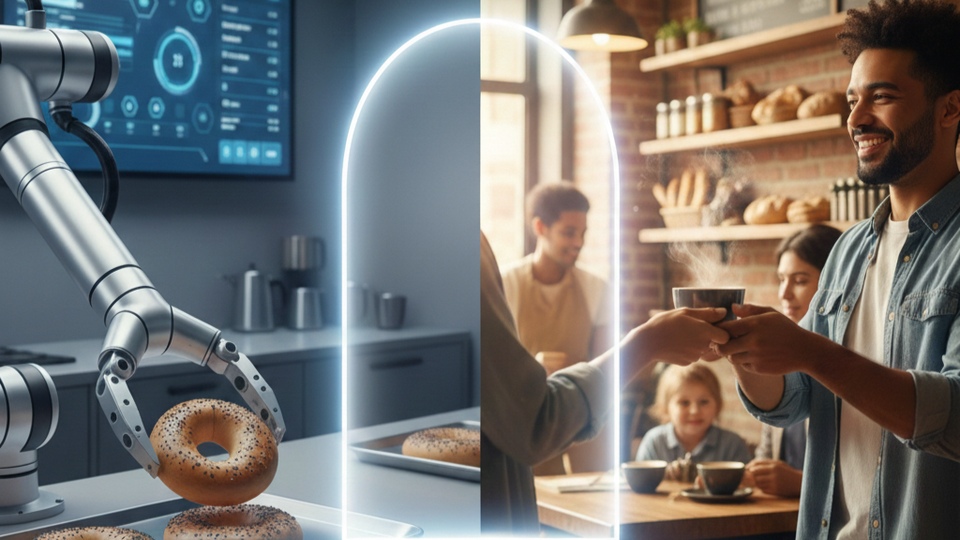
Here's where it gets interesting: What if we stopped thinking about technology as a way to only eliminate labor costs and started thinking about it as a way to reposition some of those labor dollars?
Instead of having someone standing at a register taking orders, what if that person is in the dining room creating genuine connections with guests? What if they're explaining the story behind your sourcing, or making recommendations, or just making someone's day better with real human interaction?
The efficiency gains from automation should free up resources to create human connection in new ways that guests actually value. The robots handle the repetitive tasks. The humans handle the humanity.
The macro reality we can't ignore
Of course, macroeconomic factors are driving certain directions. Rising minimum wages, labor shortages, real estate costs, supply chain pressures — these aren't going away. The operators who survive will be the ones who adapt.
But adaptation doesn't mean abandoning what makes restaurants special. It means getting smarter about where we invest our resources.
The both/and future
So yes, chase the obvious. Invest in the technology. Build efficient systems. But also, start thinking about what comes after. Start thinking about how you'll differentiate when everyone else has caught up on the tech front.
The future of fast casual isn't robots or humans. It's robots and humans, working together in ways that serve guests better than either could alone.
The question isn't whether to embrace efficiency or preserve humanity. The question is: how do we do both?
Related Media
Featured Vendor

HungerRush brings every part of your restaurant together — orders, guests, data — in one platform built for fast casual and quick-serve multi-location brands ready to grow.
Subscribe
Get the latest news and resources from Fast Casual.
Recent Posts