Operations
Driving traffic in 2026: 4 coffee chain strategies fast casuals should embrace
Fast casual brands can drive traffic in 2026 without freebies by learning from Scooter's, Starbucks, 7 Brews and Dunkin.
January 2, 2026 by Shira Petrack — Content Manager, Placer.ai
 ChatGPT
 Grok
Grok Perplexity
 Claude
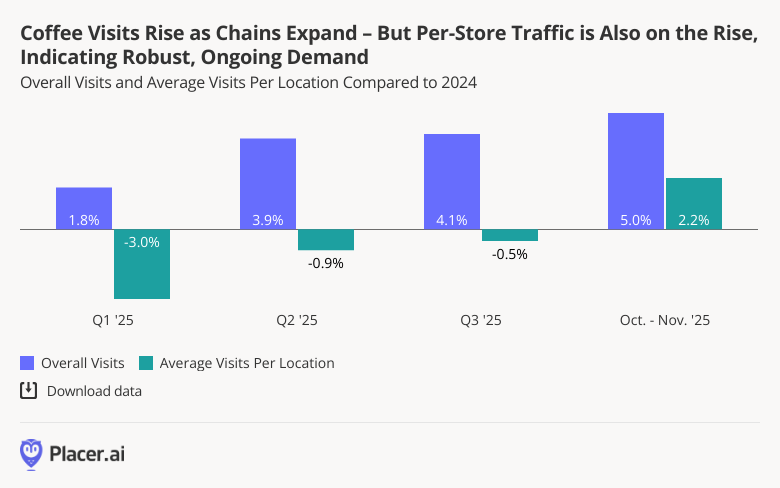
Coffee has become one of the most resilient and inventive corners of the U.S. food and beverage industry. Even as consumers wrestle with higher prices and trim discretionary spending, they continue to show up for cold foam, caffeinated boosts and treat-worthy daily indulgences. Any fast casual brand, however, can embrace four key coffee trends to drive traffic in 2026. They are:
- drive-thru efficiency.
- Recurring monthly rituals.
- High-value merch drops.
- Cultural collaborations.
1.Delivering on convenience: Scooter's Coffee
One key differentiator for the coffee sector is convenience. Drive-thrus have become ubiquitousacross the category, with many of the fastest-growing upstarts embracing drive-thru only models and legacy leaders leaning heavily into the format as well.
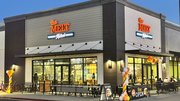
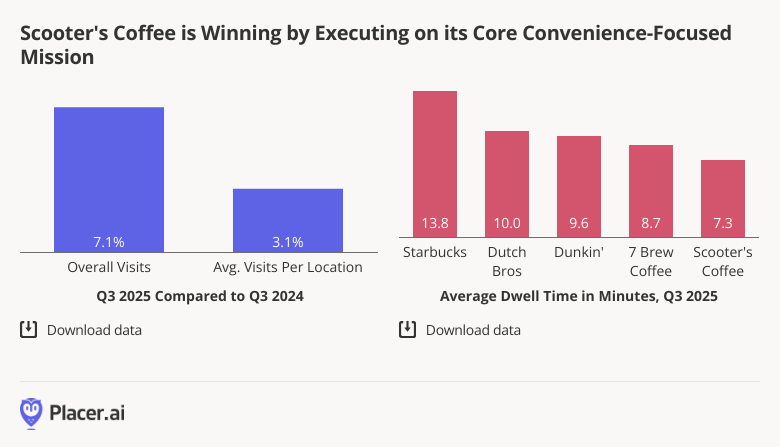
Scooter's Coffee — named for its core promise to help customers "scoot" in and out quickly — exemplifies this advantage. In Q3 2025, the chain posted a 3.1% YoY increase in average visits per location, even as it continued to scale its footprint. And its customers averaged a dwell time of just 7.3 minutes — significantly lower than other leading coffee chains, including other drive-thru-forward peers.
By delivering consistently quick experiences without compromising quality, Scooter's has emerged as a traffic leader in the coffee space – demonstrating the power of efficiency to drive demand.
2. Owning the calendar with recurring LTOs: 7 Brew
No category has mastered the "event-ization" of the menu quite like coffee, and few brands own the category's calendar as effectively as Starbucks. The annual return of thePumpkin Spice Latte has become a cultural milestone that marks the unofficial start of fall for millions, driving double-digit visit spikes and shaping seasonal traffic patterns.
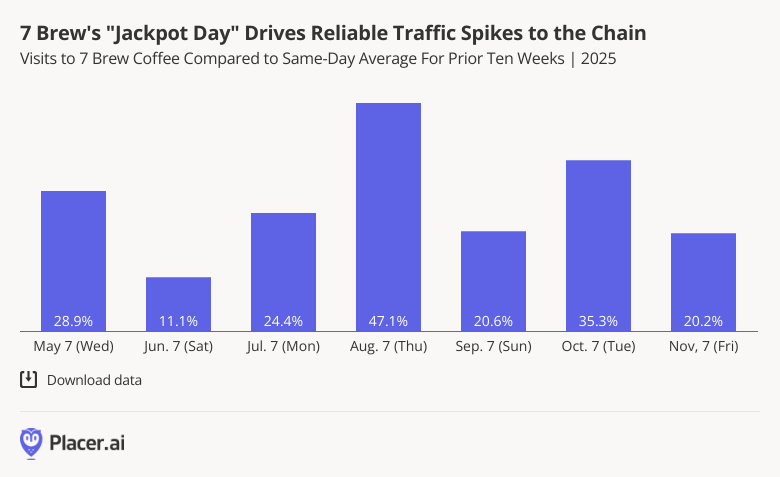
But this playbook isn't reserved for mega-brands.7 Brew's monthly Jackpot Day, held on the 7th of each month, shows how recurring promotions can also build anticipation and deliver repeatable traffic lifts for up-and-coming concepts.
These rituals create emotional consistency: Customers know when to expect something special and plan around it. Dining chains beyond the coffee space can also create dependable spikes in traffic by implementing recurring, ritualized LTOs that create an emotional calendar and keep customers engaged.
3. Moving beyond food & drink: Starbucks' Bearista win
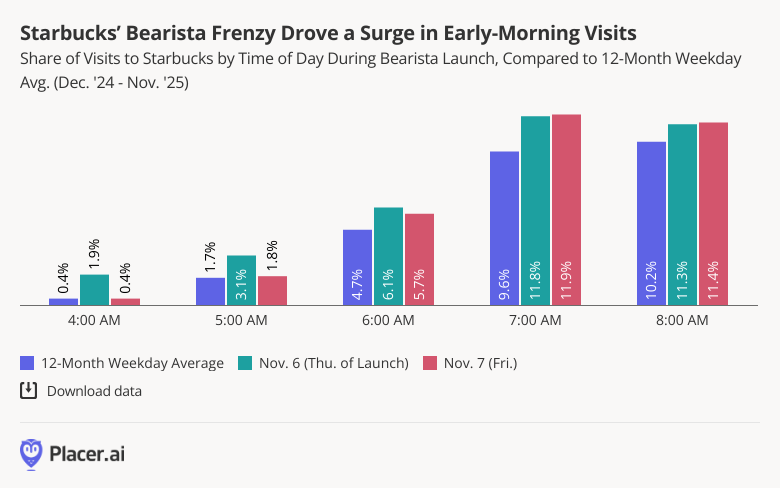
Offering recurring LTOs is one way to keep customers consistently engaged. But one-time, limited-edition merch drops can create even bigger visit surges. Starbucks' much-hyped "Bearista" launch this November is a prime example: Customers lined up nationwide for the chance to buy — not receive — an adorable, limited-edition, bear-shaped reusable cup. And despite its hefty $30 price tag, the merch drop drove a massive nationwide visit spike, making it the chain's biggest sales day ever and fueling additional momentum leading intoRed Cup Day.
Starbucks' Bearista frenzy suggests that scarcity isn't just a retail tactic – it's a powerful behavioral trigger that restaurants can harness as well. Limited-run items, exclusive merch drops, or time-bound specials can generate excitement, pull visits forward, and reshape daypart patterns in ways traditional promotions rarely do.
4. When pop culture meets coffee: Dunkin's 'Wicked' collab
Cultural tie-ins add another accelerant. In November, Dunkin' launched its Wicked collaboration alongside its holiday menu, generating a significant multi-day traffic spike — achieved, like Bearista, without giveaways. The event leaned on playful thematic branding, seasonal flavors, and limited-run items that tapped into Wicked fandom.
Dunkin's Wicked surge shows that when executed well, cultural relevance can also significantly move the needle. Other dining segments may also lean into thoughtful collabs to create outsized excitement and traffic lift — even without deep discounts or free offers.

Coffee as a playbook
The coffee sector's 2025 performance offers a blueprint for dining success: Chains are expanding smartly into underpenetrated regions, successfully implementing both hyper-efficient and hyper-personal service models, using recurring LTOs to build seasonal and monthly rituals, and leveraging merch and pop culture partnerships to reshape demand.
These strategies provide a practical playbook for dining brands to increase visit frequency, deepen customer commitment, and capture new growth opportunities in 2026 and beyond.
"This is republished with permission from Placer.ai and the original article can be found here.
FAQ: Applying the 2026 coffee playbook to fast casual
What are the most effective traffic-driving strategies for 2026?
The coffee sector has proven that operational efficiency, recurring ritual-based marketing, scarcity-driven merchandise, and pop-culture collaborations are the most effective ways to drive traffic. Brands like Scooter's Coffee and 7 Brew have seen significant visit spikes by focusing on these pillars.
How does service speed impact customer traffic?
Data from Scooter's Coffee shows that a low dwell time — averaging just 7.3 minutes — is a primary driver of repeat business. For fast-casual operators, optimizing service cycles to reduce friction is a key differentiator that builds long-term loyalty and increases throughput.
Why are recurring LTOs important for restaurants?
Recurring promotions, such as 7 Brew's monthly "Jackpot Day," create an "emotional calendar" for the consumer. By turning a promotion into a predictable ritual, brands can generate dependable, repeatable traffic lifts that customers plan for in advance.
Can merchandise drive restaurant visits without discounts?
Yes. Starbucks' "Bearista" cup launch proved that high-quality, limited-edition merchandise can drive record-breaking sales days. Scarcity acts as a behavioral trigger that pulls visits forward and increases brand affinity without the need for price cuts.
How do cultural collaborations benefit fast-casual brands?
Collaborations like the Dunkin' x Wicked partnership allow brands to tap into existing fanbases. These events create excitement and traffic surges by making the menu feel culturally relevant and "of the moment" for a specific audience.
About Shira Petrack

Related Media
Featured Vendor

HungerRush brings every part of your restaurant together — orders, guests, data — in one platform built for fast casual and quick-serve multi-location brands ready to grow.
Subscribe
Get the latest news and resources from Fast Casual.
Recent Posts