Food & Beverage
Don't bet the house on GLP-1: Why 'Everyday Health' is the better menu strategy
February 27, 2026 by Suzy Badaracco — President, Culinary Tides Inc
 ChatGPT
 Grok
Grok Perplexity
 Claude
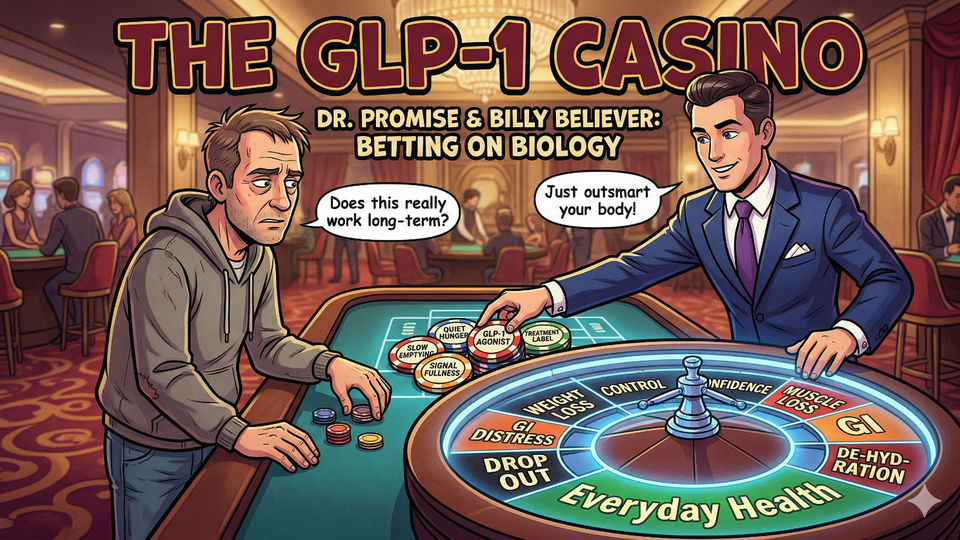
The modern restaurant menu has become a casino floor. The lighting is dimmed to hide the margins, the air is thick with the scent of "better-for-you" trends, and in the center of the room, a new game is being played: The GLP-1 Bet.
Across the country, operators are rushing to label their items "GLP-1 Friendly," hoping to capture the attention of a new, chemically altered consumer. But like any casino, the house, in this case, the drug manufacturers and the trend-chasing hype, has a significant advantage.
While operators gamble on niche labeling to capture short-term traffic, they are losing sight of the only bet that pays off consistently: Everyday Health.
When you design a menu for "Everyday Health," you win the GLP-1 user and the health-conscious athlete, the time-strapped parent and the clean-label advocate.
But before you place your chips on the table, you need to understand the odds. Let's look at how the game is actually rigged.SETTING
INSIDE CASINO — NIGHT
This casino hums, but never roars. No bells. No flashing lights. No clocks.
The lighting is warm and calming. The air carries a faint scent of polish and perfume. Thick carpet absorbs every sound, intentionally quieting the room.
At the center of the room stands a roulette table, glowing softly. The wheel's segments are not numbered. They are labeled with outcomes.
Behind it is GLP-1, masquerading as Dr. Promise — not hiding, exactly, just reframed.
He is immaculately dressed. Tailored suit. Unwrinkled cuffs. The posture of someone who has never had to hurry. His voice is smooth, reassuring, practiced — equal parts clinician and confidant, the cadence of someone accustomed to explaining side effects without alarming patients. Hunger is not part of his jurisdiction.
Across the table stands Billy Believer.
Billy is not naïve. He is tired. The kind of tired that comes from effort— years of trying, tracking, adjusting, restarting. He has read the studies. He has followed the plans. He has done the work.
What he wants now is relief. Not another lecture.
The roulette wheel turns slowly between them.
SCENE 1: OPENING BET
DR. PROMISE
You know, most people think discipline is the problem. They think if they could just try harder—count more carefully, restrict more precisely—everything would finally fall into place.
(He smiles.)
But discipline isn't the issue here.
(Billy watches the wheel.)
DR. PROMISE (CONT'D)
You don't need to fight your body. You just need to outsmart it.
He slides chips across the felt. Each is cleanly labeled.:
"WEIGHT LOSS. CONTROL. CONFIDENCE."
Billy hesitates, then picks one up.
BILLY BELIEVER
And this actually works?
DR. PROMISE
It works the way physiology works.
He gestures toward Billy's midsection, not unkindly
DR. PROMISE (CONT'D)
GLP-1 mimics a hormone your body already makes. It quiets the appetite. Slows gastric emptying. Signals fullness earlier.
Researchers at Harvard Medical School and the University of Copenhagen mapped this pathway years ago. This isn't theory. It's biology.
Billy nods. He places the chip down. The wheel spins.
SCENE 2: BEGINNER'S LUCK
MONTAGE
— The scale number drops.
— Billy's belt tightens.
— Compliments arrive without prompting.
DR. PROMISE
See? Your body responds when it's given the right signals. Meals shrink. Sometimes it disappears. You're pushing plates away halfway through. Food loses urgency.
BILLY BELIEVER
I'm just… not hungry.
DR. PROMISE
Exactly.
He watches Billy closely.
DR. PROMISE (CONT'D)
This doesn't teach you to eat differently. It makes you eat less. Purchasing patterns don't suddenly get "healthier." They simply get smaller.
Billy shrugs.
BILLY BELIEVER
The results feel good. But you're right, I report I am eating healthier, but it isn't really true. If I had good eating habits, I wouldn't have needed this help in the first place.
The wheel spins again.
SCENE 3: THE WHEEL REVEALS ITSELF
The ball lands. MUSCLE LOSS. Billy frowns.
BILLY BELIEVER
That's not ideal—but weight is weight, right?
(Cut to Billy climbing stairs. Slower. Breathing heavier than expected. A gym mirror. Arms that look smaller—but not stronger.
DR. PROMISE
Up to 40% of the weight lost on GLP-1 therapies comes from lean muscle loss. That figure shows up again and again in clinical body-composition work summarized by Harvard University and University of Virginia following real patients—not models.
Billy flexes. Nothing answers back.
DR. PROMISE (CONT'D)
When appetite disappears, protein often goes with it. And muscle, once lost, is expensive to rebuild.
The wheel turns.
SCENE 4: THE HOUSE ODDS
The spins come faster now. DE-HYDRATION. GI DISTRESS. THYROID TUMORS. HAIR LOSS.
BILLY BELIEVER
Nothing tastes as good anymore.
Billy skips breakfast. Lunch sits untouched.
DR. PROMISE
Oh I forgot to mention that one. Side effects vary.
He says it the way clinicians do—accurate, noncommittal.
DR. PROMISE (CONT'D)
Gastrointestinal discomfort is one of the leading reasons causing patients to discontinue use. GLP-1 users often suffer from gastrointestinal side effects like nausea, reflux, constipation, and frozen gut.
Billy lifts a glass of water. Sets it down again.
DR. PROMISE (CONT'D)
ADM researchers found 44% of users report reduced thirst. Hard to nourish a body that doesn't ask for fuel … or fluid.
The wheel spins again.
SCENE 5: THE BIG NUMBER
The ball stops hard. DROP OUT. The casino quiets.
DR. PROMISE
But University of Pennsylvania, Prime Therapeutics and Magellan Rx tell a consistent story - 53% discontinue GLP-1 use within the first year. And 75% quit by year two.
Billy looks up.
DR. PROMISE (CONT'D)
Only 6% say they intend to stay on long-term. Those numbers come from Kerry's analyses paired with pharmacy-data tracking. They're not speculation. After all, it was developed for diabetics, and they are the ones expected to remain on it long term.
BILLY BELIEVER
Why didn't you say that sooner?
Dr. Promise meets his gaze.
DR. PROMISE
You didn't ask.
SCENE 6: THE NOPE MOMENT
The wheel flashes red.
OBESITY RATES.
The lighting shifts—brighter now, less forgiving.
DR. PROMISE
Despite the headlines, national obesity rates haven't declined since GLP-1s entered the market in 2013.
The CDC NHANES study tracks this biannually. In fact, severe obesity has increased 7.7%-9%.
Billy steps back.
BILLY BELIEVER
So the game doesn't change the system? I thought I heard that obesity rates have dropped slightly.
DR. PROMISE
No. You are thinking of surveys; I am talking about actually reported clinical data. Until NHANES next reporting, the answer is obesity rates = zero change, severe obesity still rising.
BILLY BELIEVER
But I heard people on these drugs are buying less food. Grocery sales are down because of it.
Dr. Promise smiles slightly.
DR. PROMISE
That headline traveled fast.
He circles the roulette wheel slowly.
DR. PROMISE (CONT'D)
Circana tracked purchasing behavior. What they found wasn't collapse — it was redistribution. Users didn't stop buying food. They shifted channels. More prepared foods. More foodservice. Different formats.
The wheel clicks once.
DR. PROMISE (CONT'D)
And Cornell University reported that whatever short-term reduction showed up in grocery baskets disappeared after six months.
BILLY BELIEVER
Disappeared?
DR. PROMISE
The body compensates. Or the consumer overrides the signal. Satiety suppression is not a behavior change. Appetite can be quieted. Patterns are more stubborn.
He meets Billy's eyes.
DR. PROMISE (CONT'D)
It just changes the experience for a while. GLP-1 suppresses hunger. But it doesn't teach healthy eating. Just because companies are producing "GLP-1 friendly foods", doesn't mean GLP-1 users want that food. Unless they are under the care of a dietitian, their old eating patterns will persist, they just eat less.
BILLY BELIEVER
I hate to agree, but I didn't like broccoli before; I certainly don't magically want it now. I just figured this would be an easy way to lose weight.
DR. PROMISE
Welcome to America!
SCENE 7: MARKED AT THE TABLE
Billy opens a lunch bag. Inside: a product clearly labeled "GLP-1 FRIENDLY." The roulette wheel slows. Clicks. Stops.
DR. PROMISE
Labels are helpful… until they explain too much.
WORKPLACE
A breakroom. A coworker glances at the package.
COWORKER
Are you on one of those drugs?
Billy freezes—not embarrassed, but exposed.
DR. PROMISE
That label doesn't say "high protein." It says medical. It says treatment.
Billy folds the wrapper inward.
HOME
A family table. One shared meal. Billy places his smaller, labeled item beside the plate.
No one comments. The separation is enough.
DR. PROMISE
At home, it divides the table. One meal for the family. Another for the program.
Back at the casino
BILLY BELIEVER
So this was never about helping me eat.
DR. PROMISE
It was about identifying you. When food names the drug, it marks the eater. And marked consumers don't stay loyal. They don't complain. They disappear.
SCENE 8: EVERYDAY HEALTH, REAL LIFE
The casino dissolves. Morning commuters. Students studying. Shift workers. Parents. Active adults.
NARRATOR
The mistake isn't supporting GLP-1 users. The mistake is building food only for them.
A much wider audience is already seeking the same meal pattern:
- Morning commuters who need steady energy without heaviness.
- Office workers powering through mid-day without crashing.
- Active adults looking for clean protein after workouts.
- Health-focused eaters managing portions.
- Stressed professionals who want something balanced, not indulgent.
- Parents grabbing something practical for themselves and the kids between obligations.
There aren't GLP-1 foods. There are Everyday Health foods.
People don't shop by drugs. They shop by dayparts, energy needs, and how food fits real life.
Design principles appear quietly — demonstrated, not declared:
• Protein-forward.
• Supports digestion.
• Portion-flexible.
• Approachable enough to share.
NARRATOR
Long-term health doesn't come from restriction.
It comes from repeatable, realistic choices.
Winning foodservice and retailers don't chase trends — they support how people actually live.
FINAL MOMENT
Billy eats with others. Same foods. Different portions.
Guided now — by a dietitian. By a trainer.
Not chasing promise. Building discipline.
No label. No explanation.
NARRATOR
When food supports everyday health, it outlives trends, drugs, and hype.
FADE OUT.
About Suzy Badaracco

Related Media
Food & BeveragePresented ByOracle
Featured Vendor

HungerRush brings every part of your restaurant together — orders, guests, data — in one platform built for fast casual and quick-serve multi-location brands ready to grow.
Subscribe
Get the latest news and resources from Fast Casual.