Restaurant Franchising & Innovation Summit
Restaurant leaders share tips for driving growth, innovating when franchising
At the upcoming Restaurant Franchising & Innovation Summit, top restaurant executives will share how they’re scaling smarter and growing faster through bold innovation.
January 21, 2026 by Judy Mottl — Editor, RetailCustomerExperience.com & DigitalSignageToday.com
 ChatGPT
 Grok
Grok Perplexity
 Claude
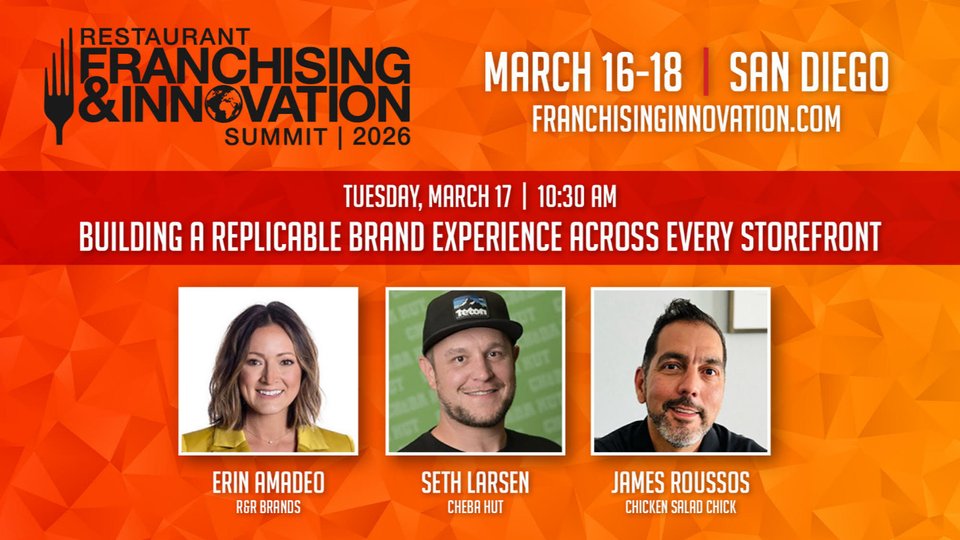
At the upcoming Restaurant Franchising & Innovation Summit, taking place March 16-18, 2026, in San Diego, California, top restaurant executives will share how they're scaling smarter and growing faster through bold innovation.
One panel, "Building a Replicable Brand Experience Across Every Storefront," will tackle the topic of building a replicable brand experience across every storefront — a critical aspect as a brand's promise hinges on a consistent experience.
The session will equip both franchisors and franchisees with the tools and frameworks to standardize operational best practices, maintain product quality, ensure brand messaging resonates uniformly and manage localized marketing efforts without diluting the core brand identity, no matter the zip code. Register here for RFIS.
Panelists include Erin Amadeo, chief marketing officer at R&R Brands, Seth Larsen, chief relationship officer at Cheba Hut and James Roussos, franchise business consultant at Chicken Salad Chick.
FastCasual reached out to Amadeo, Larsen and Roussos to get a preview of the expert insight they will be sharing during the panel talk.
Q. What's the first step in creating standard operating procedures that are easily implementable and scalable across all locations?
Larsen: I think the first question you should ask is if the franchisees are even asking for it. If they aren't asking for it, they probably don't need it, and therefore it will be really difficult to get buy-in and adoption. For larger, systemwide updates we start with our advisory council that is made up of seven franchise groups. If we get buy in and feedback there first, it tends to be an easier rollout process across the system. Our LMS platform has improved every year and we will continue to invest in that.
Always operate and make decisions with the crew member in mind. It is not us sitting in an office that will have to roll sop's out to 35 crew members. It's our owners, GM's, and other key people at the store level.
Roussos: I'd have to say the main focus in creating SOPs, would be that they are able to be easily taught and implemented. We need to explain the vision and outcomes, not the actual tasks — that's for later. Before documenting how things are done, we have to be clear about the global vision, at every location, regardless of size, market, or operator. SOPs often fail because they address current habits instead of desired standards and long-term visions.
Scalability requires clarity on outcomes that can be reproduced, measured, and coached globally.
If operators, trainers, and field leaders don't agree on the standard, the SOP will never scale. You will naturally have to ask yourself, and leadership could a brand-new operator, in a new market, learn, understand and execute the standard SOP's without tribal (external shortcut) knowledge? If the answer is no, it (the SOP) isn't clear enough yet
SOPs are about support, not "brand mandates" or "you musts." When expectations are clear, taught well and the vision is explained, teams feel a sense of confidence, they trust the system, and execute with consistency.
High-performing companies look at SOP as shared ownership results with continuous improvement and education.
Amadeo: Honestly, the first step isn't writing anything down. It's starting with the why. Before you document a process, teams need to understand why it exists and what problem it's solving. That clarity drives alignment and buy-in.
From there, you get very clear on what actually needs to be standardized versus where teams can have flexibility. For example, how a steak is cooked, plated, and timed absolutely needs to be consistent. How a GM motivates their team before a shift does not.
One of the biggest mistakes I see is brands trying to document everything instead of focusing on the few non-negotiables that truly protect the guest experience, the brand, and the margins. When SOPs are built around those priorities and explained in plain language, they're easier to train, easier to reinforce and far more likely to scale.
The strongest SOPs are built with operators, pressure-tested in real restaurants and designed to work on a busy Friday night, not just look good in a binder.
Q. Who should be involved within the enterprise when it comes to effective quality control and audit mechanisms to ensure consistent product and service delivery?
Larsen: QC and audits are firmly in the Ops department, although you can learn much about a particular location by reviewing guest sentiment. It's about honest, open and transparent feedback between HQ and the shops.
Amadeo: Quality control works best when it's transparent and developmental, not punitive. Operations owns execution. Marketing protects how the brand shows up for the guest. Culinary safeguards product integrity. Finance ensures standards are being met in a way that protects the bottom line.
Just as important, field leadership and store teams need visibility into the process, even when parts of it sit outside their direct scope. That visibility builds context, sharper decision-making, and professional maturity across the organization.
Audits should function as coaching tools. For example, if an audit surfaces inconsistent portioning, the goal isn't just a score. It's understanding the root cause, retraining where needed, and reinforcing why the standard matters in the first place. When teams understand the why and see audits as support, consistency follows.
The best systems are simple and shared: clear expectations, easy-to-read scorecards, regular coaching and real accountability.
Roussos: Effective processes only work when they are owned system wide — not delegated to a single department.
Consistency is a system, a "culture" that is developed, if you will. It should not be a result of an inspection or "audit." It should come from education and support.
About Judy Mottl

Related Media
Subscribe
Get the latest news and resources from Fast Casual.